Hurricane Season Prep: Backup Internet Options for Your Home
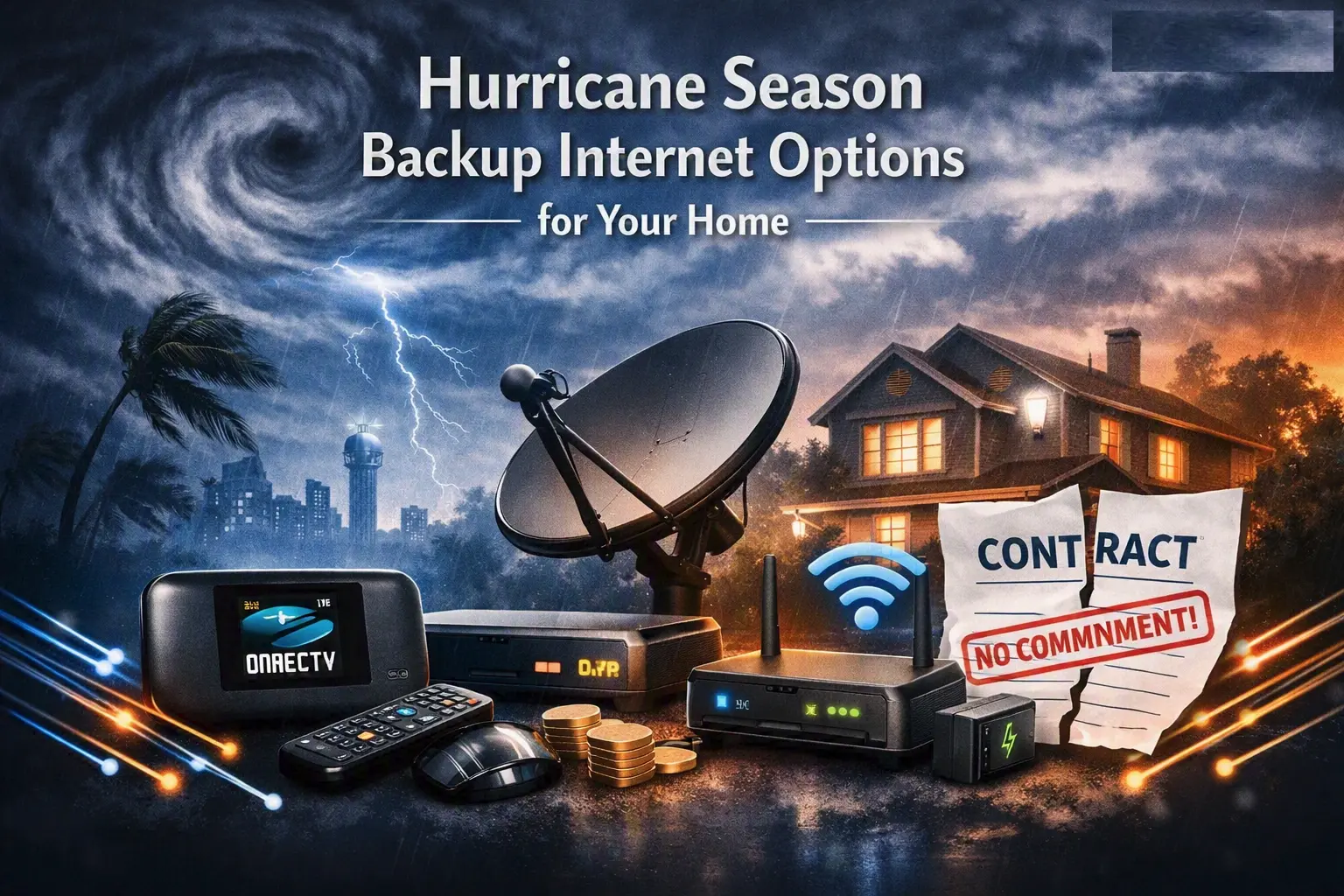
No single backup internet option is failure-proof during a hurricane, but layering two technologies dramatically improves your odds of staying connected. Satellite internet (like Starlink) survives cell tower outages because it doesn't rely on local infrastructure. At the same time, a cellular hotspot on a second carrier provides a low-cost backup as long as at least one network stays partially up. Battery or generator backup for whatever router or hotspot you choose matters as much as the connection technology itself, since power loss — not just damage — is the leading cause of outages during storms.
Key Findings
The National Oceanic and Atmospheric Administration's 2026 Atlantic outlook calls for a below-normal season, with 8 to 14 named storms, 3 to 6 hurricanes, and 1 to 3 major hurricanes forecast ahead of the June 1 start, compared with a 14-storm average season.NOAA's outlook for the 2026 Atlantic hurricane season, which runs June 1 to November 30, predicts a 35% chance of a near-normal season, a 10% chance of an above-normal season, and a 55% chance of a below-normal season. The agency forecasts a total of 8-14 named storms, of which 3-6 are forecast to become hurricanes, including 1-3 major hurricanes, versus an average season of 14 named storms with seven hurricanes, including three major hurricanes.
A below-normal forecast is not a guarantee of a quiet season. NOAA's National Weather Service Director Ken Graham noted that while El Niño's impact can often suppress hurricane development, there is still uncertainty in how each season will unfold, and it only takes one storm to make for a very bad season.
Hurricane Helene in September 2024 caused the most extensive cell site failure ever recorded in a hurricane. According to the FCC, 3,432 cell sites were down along the five-state path Helene carved after landfall, a figure that had already fallen from the previous day's record-setting 4,562 outages. In North Carolina, 74.31% of cell sites in affected counties were offline, while Florida fared far better at just 2.58% of its cell sites down.
Power loss, not physical damage, is usually the biggest driver of these outages. FCC county-level data from Helene showed most out-of-service sites were flagged as down due to lost power or backhaul transport problems rather than direct storm damage to the tower itself.
Hurricane Milton, which struck three weeks after Helene, knocked out roughly one in eight Florida cell sites. A total of 1,953 cell sites in Florida were out of service due to Hurricane Milton, representing 12.3% of the state's 15,877 cell sites, and of those offline sites, only 16 were out due to physical damage while 1,351 were out due to lack of power.
Satellite hardware costs have dropped sharply, making it a realistic backup option for ordinary homeowners rather than just RVers and boat owners. Starlink Mini hardware pricing fell from $599 at its 2024 launch to as low as $199 in 2026, and the Roam 100GB plan now includes 100GB of high-speed data at the same $50-per-month starting price it once offered for only 50GB.
Why home internet fails during hurricanes
Most residential internet — cable, fiber, and DSL — depends on wireline infrastructure: utility poles, buried cable, and neighborhood distribution nodes that all need continuous power. Cellular networks depend on cell towers, which the FCC's own resiliency guidance treats as inherently redundant but not indestructible. Wireless networks are often designed with numerous, overlapping cell sites that provide maximum capacity and continuity of service even when an individual site is inoperable, and providers frequently deploy temporary facilities such as cells-on-wheels, increase power at operational sites, or initiate roaming agreements to maintain service during emergencies. That redundancy helps, but it isn't absolute — as Helene and Milton showed, entire counties can still lose the majority of their coverage for days.
The practical implication for homeowners: any backup plan built entirely around your phone's hotspot is only as reliable as the local cell tower it depends on, and that same tower is the one most likely to be knocked out along with your home internet.
Satellite internet: the option least tied to local infrastructure
Because satellite internet connects your home directly to orbiting satellites rather than a nearby tower or cable node, it sidesteps the single biggest point of failure in a hurricane. Starlink is the most widely available consumer option, and its portable Mini terminal has become notably cheaper and more capable.
The current Starlink Mini weighs about 2.56 pounds, delivers real-world download speeds in the 177–230 Mbps range, and can run for 4 to 6 hours on a 100-watt USB-C power bank when paired with a DC adapter. That battery compatibility is what makes it genuinely useful for storm prep — you don't need home power or even a generator to keep it running through a short outage. Starlink's Maritime-grade hardware is explicitly built to survive extreme temperatures, heavy rain, and hurricane-force winds, though that tier is priced for boats and commercial vessels rather than a typical household.
For most homeowners, the relevant tradeoff is cost versus commitment. Starlink Roam plans range from a 100GB tier at $50–55 per month up to unlimited data at $165–175 per month, with a mid-tier 300GB option holding at $80 per month. A homeowner who only wants satellite as an emergency fallback, rather than a full-time connection, can generally pause billing between storms and reactivate before landfall, which keeps annual cost manageable.
Cellular hotspots and multi-SIM devices
A mobile hotspot on a carrier different from your primary home ISP is the lowest-cost backup option, and it's worth having even if you also invest in satellite, since the two fail independently. If your primary carrier's local towers go down but a competitor's don't, a second-carrier hotspot can bridge the gap.
The Helene and Milton data are useful here for setting realistic expectations. In areas impacted by Helene, 21.7% of cell sites were experiencing outages, with wireless disruptions most severe in Florida and North Carolina; Florida alone saw 36.7% of cell sites out of service at the peak of that particular report. A single-carrier hotspot in one of those counties would have been useless. A dual-SIM or multi-carrier device meaningfully improves the odds that at least one network stays partially available.
Backup power is not optional
Across both storms referenced above, the FCC's own damage categorization makes the priority clear. Of Milton's nearly 2,000 offline Florida cell sites, the overwhelming majority — 1,351 — were down due to lack of power, compared to just 16 due to direct physical damage. The same pattern held for Helene, where power and backhaul transport issues, not wind damage to towers, accounted for most outages.
This means the single highest-leverage hurricane prep step for connectivity isn't necessarily buying new hardware — it's making sure whatever router, hotspot, or satellite terminal you already have can run on battery or generator power. A satellite dish with no power source is just as offline as a fiber modem with no power source.
Wired landline and mesh radio as a last resort
For households in areas with spotty cell and satellite line-of-sight (heavy tree cover, apartment complexes without balcony access), a battery-powered mesh radio device (such as goTenna or similar off-grid text/location tools) won't provide internet access but can maintain basic communication with family members nearby when both cellular and Wi-Fi networks are down. This isn't a substitute for internet access, but it's a low-cost addition to a broader emergency communication plan.
Research Insights
The clearest trend across three consecutive hurricane seasons (2022–2025) is that outage severity correlates far more with power grid resilience than with a storm's peak wind speed. Milton was a powerful storm at landfall, yet its cell outages were driven almost entirely by power loss rather than structural damage to towers — a pattern the FCC's damage-cause breakdowns confirm year after year. This has a direct implication for consumers: a backup internet plan that assumes "the tower will just come back" underestimates how long power restoration can take in rural and semi-rural counties, which are often deprioritized relative to dense population centers during utility crews' restoration sequencing.
It also explains why satellite internet has moved from a niche RV product to a mainstream disaster-prep purchase in just two years. As hardware prices have fallen — from $599 at launch to as little as $199 today — the total cost of owning a "just in case" satellite terminal has dropped below what many households already spend annually on storm shutters or a basic generator, while offering a form of resilience neither of those provides.
One caution worth noting: satellite capacity is not infinite. During large-scale regional disasters, a spike in new satellite internet signups in an affected area can create local network congestion, similar to how cell towers get overloaded when everyone in a neighborhood tries to call out at once. Homeowners who wait until a storm is already forecast to make landfall before ordering hardware may find shipping and setup timelines don't favor last-minute preparation — buying and testing equipment during the calm part of the season is the more reliable approach.
Consumer Impact
For most households, the realistic cost of a layered backup plan is modest relative to potential losses from being unreachable during an emergency: a security check on elderly relatives, insurance claim filing, remote work continuity, or simply knowing when to evacuate. A Starlink Mini plus an occasional-use Roam plan, combined with a $10-a-month second-carrier hotspot SIM and a portable power bank, generally lands in the range of a few hundred dollars upfront and $50–100 per month during active storm months — payable only when needed, since most plans support pausing service outside hurricane season.
Households in manufactured housing, mobile homes, or areas with poor cell coverage even in good weather should weigh satellite more heavily, since they're statistically more exposed to both wind damage and extended power restoration timelines.
Future Outlook
NOAA and NOAA's National Weather Service say they are integrating AI-based weather models, drones, and next-generation satellite data to deliver more accurate storm forecasts, which should give households more lead time to prepare connectivity backups before landfall rather than during it. On the infrastructure side, low-earth-orbit satellite constellations are still expanding capacity, and Starlink's pricing history over the past two years suggests continued downward pressure on hardware costs even as monthly service pricing has ticked upward. Consumers weighing whether to buy now versus wait should expect that pattern to continue: cheaper terminals, but service plans that increasingly reflect actual demand and network capacity rather than promotional discounting.
Frequently Asked Questions
Will Starlink work if my power goes out during a hurricane?
Starlink's dish and router need power to operate, but the compact Mini terminal can run for several hours on a portable USB-C power bank with the right adapter. For longer outages, pairing it with a small generator or a solar power station extends runtime significantly. Without any backup power source, though, satellite internet goes down just like any wired connection.
How much of an area's cell service typically goes down in a major hurricane?
It varies enormously by storm and location. Hurricane Helene knocked out roughly 22% of cell sites across its full impact area, but that figure exceeded 74% in the hardest-hit North Carolina counties. Hurricane Milton, by contrast, affected about 12% of Florida's cell sites overall. Local terrain, storm track, and grid resilience all matter more than the storm's official category.
Is a cellular hotspot enough backup on its own?
It can help, but only if the specific towers serving your area stay up. Since your primary home internet and a single-carrier hotspot often depend on infrastructure in the same local grid, a hotspot on a different carrier than your phone's usual provider improves your odds more than a same-carrier backup.
Do I need to buy backup internet equipment before hurricane season starts?
Yes, ideally. Equipment shipping times and your own ability to configure and test a new device both work against you if you wait until a storm is already approaching. Testing a satellite terminal or hotspot during calm weather also reveals any dead zones on your property before you're relying on it in an emergency.
What's the difference between Starlink Roam and Starlink Residential for storm backup purposes?
Residential plans are designed as a primary home connection at a fixed address and generally cost less per month for unlimited data. Roam plans are designed for portability and intermittent use, letting you pause billing between storms — which usually makes more financial sense for a backup-only setup than paying for a full residential plan you rarely use.
Can I use a generator to power my home Wi-Fi router during an outage?
Yes, and it's one of the simplest backup steps available. A router and modem draw very little power compared to major appliances, so even a small inverter generator or a battery power station can keep your existing internet equipment running as long as the underlying connection (cable, fiber, or satellite) itself is still functioning upstream.
Conclusion
FCC outage data from recent hurricanes consistently shows the same pattern: power loss, not wind damage, disables most of the connectivity infrastructure that goes dark during a storm. That single fact should drive most of a household's backup internet planning. Satellite internet offers a genuine, infrastructure-independent alternative, and its falling hardware costs have made it realistic for ordinary homeowners rather than just niche use cases. Layering it with a second-carrier cellular hotspot, and making sure both can run on battery or generator power, gives most households a meaningfully better chance of staying connected through the next major storm.
Consumers can compare current provider availability and coverage details for their specific address on CtvforMe.com, and can also call (855) 210-8883 to check regional satellite and wireless backup options ahead of this year's storm season.