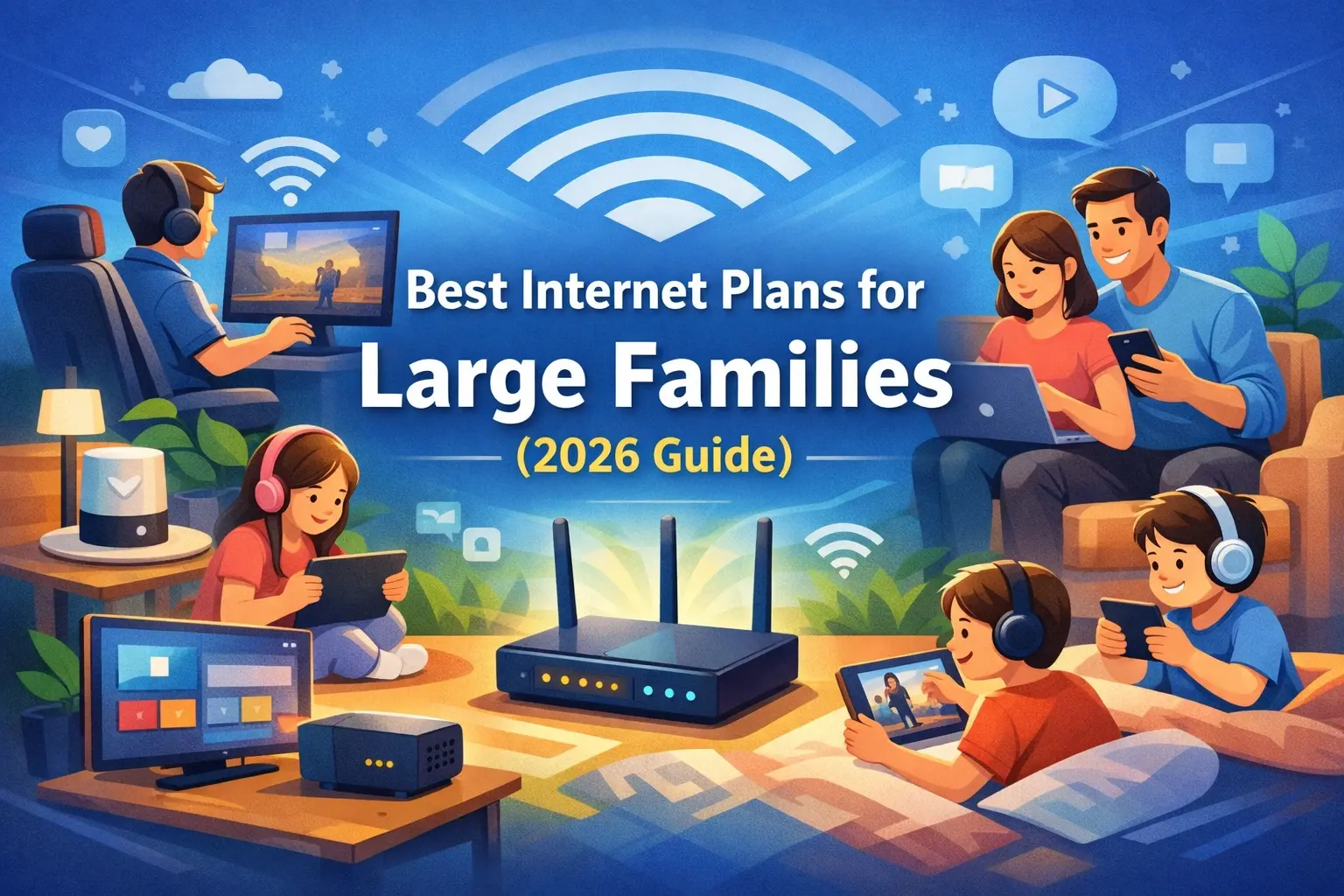
Best Internet Plans for Large Families (2026 Guide)
Large families — five or more people with heavy simultaneous usage — need at least 500 Mbps, ideally 1 Gbps, to stay ahead of peak-hour demand. The best plan in 2026 is AT&T Fiber 1000 at $80/month: symmetrical gigabit speeds, no data caps, no equipment rental fee, no annual price increases, and a Wi-Fi 6 gateway included. Where AT&T Fiber isn't available, Spectrum Internet Ultra (500 Mbps, $69.99/month, no caps) and T-Mobile Home Internet ($50/month, no caps, no contract) are the strongest alternatives. The provider to avoid in a large household: any plan with a 1.2 TB monthly data cap and upload speeds below 20 Mbps — which describes Xfinity's cable tiers and will catch up with you by month two. For a same-address availability check across all providers in your area, call (855) 210-8883.
Key Findings at a Glance
Provider & Plan | Speed | Data Cap | Price | Equipment Fee | Best For |
|---|---|---|---|---|---|
AT&T Fiber 1000 | 1 Gbps / 1 Gbps | None | $80/mo | $0 (included) | Best overall — families of 4–6 |
AT&T Fiber 300 | 300 Mbps / 300 Mbps | None | $55/mo | $0 (included) | Smaller, large families, budget fiber |
AT&T Fiber 2000 | 2 Gbps / 2 Gbps | None | $110/mo | $0 (included) | Power users, 30+ device households |
500 Mbps / 20 Mbps | None | $69.99/mo | $5/mo (optional) | Best cable alt where fiber is absent | |
T-Mobile Home Internet | 33–450 Mbps | None | $50/mo | $0 (included) | No-contract households, renters |
Verizon Fios Gigabit | 940 Mbps / 880 Mbps | None | $90/mo | $0 | Verizon wireless customers (bundle discount) |
Xfinity Gigabit | 1,200 Mbps / 20 Mbps | 1.2 TB* | $80–100/mo | $15/mo (gateway) | Last resort where fiber is unavailable |
Google Fiber 1 Gig | 1 Gbps / 1 Gbps | None | $70/mo | $0 | Best speed-per-dollar, very limited availability |
*Xfinity's 1.2 TB cap can be lifted with the xFi Complete package ($25/month), which effectively raises the true monthly cost to $105–125/month.
Pricing as of June 2026. Promotional rates apply; verify at your address by calling (855) 210-8883.
Introduction
Here's the math problem that most internet providers don't put in their advertising: every 4K stream needs 25 Mbps. Every Zoom call burns 5 Mbps up and down. Every active gaming session adds 3–5 Mbps of latency-sensitive traffic. Every always-on smart home device — thermostat, security camera, voice assistant, smart TV in standby — contributes background load even when nobody's actively using it.
Now add five people to that equation. Or six. Or the household where both parents work from home, two teenagers are online gaming in their rooms, a nine-year-old is streaming cartoons on a tablet, and the baby monitor is running a constant video feed to someone's phone.
The average U.S. household now has 15 to 25 connected devices. Large families — five or more people — routinely exceed 30. That's not a household with heavy internet usage. That's a small office building running on residential infrastructure.
The baseline most internet providers advertise — 100 Mbps, 200 Mbps — is genuinely sufficient for smaller households. It is not sufficient for this. SpeedTestHQ's 2026 analysis puts the minimum for a connected family of five at 200 Mbps under light conditions, rising to 500 Mbps or more during peak evening hours when everyone is home and active simultaneously. The industry consensus from multiple 2026 reviews: 500 Mbps is the floor for large families, and 1 Gbps is the ceiling you want to stay under rather than bump against.
This guide covers the plans that actually hold up under that load — the providers, the pricing, and the specs that matter when the whole family is online at 7 p.m.
How Much Speed Does a Large Family Actually Need?
Before comparing providers, the speed question deserves a direct answer — with real numbers, not marketing ranges.
The calculation: Add up simultaneous peak demands, then add a 25% buffer for background processes and devices you forgot to count.
A realistic large family scenario at peak hour:
2 parents, each on a video call (Zoom, Teams): 5 Mbps × 2 = 10 Mbps down, 10 Mbps up
2 teenagers, each 4K streaming: 25 Mbps × 2 = 50 Mbps down
1 child on a streaming tablet (HD): 5 Mbps = 5 Mbps down
1 child gaming online: 3 Mbps down, 1 Mbps up = 3 Mbps down, 1 Mbps up
Smart home devices (cameras, TV standby, thermostat, etc.): ~15 Mbps background load
Raw total: ~83 Mbps down, 11 Mbps up. Add 25% buffer: ~104 Mbps down, ~14 Mbps up.
That's a moderate evening. Now add a second gaming session, a 4K TV in the living room nobody turned off, a security camera uploading footage, and a cloud backup running on someone's laptop — and you're pushing 200 Mbps down without breaking a sweat.
The practical recommendation across multiple 2026 industry analyses:
Household Size | Minimum Speed | Recommended Speed |
|---|---|---|
Family of 3–4, moderate use | 200 Mbps | 300–500 Mbps |
Family of 5–6, heavy use | 500 Mbps | 1 Gbps |
Family of 6+, 20+ devices, WFH | 1 Gbps | 2 Gbps |
The reason the recommendations skew higher than the raw math: internet plans don't deliver their maximum speed consistently. Cable connections, in particular, experience congestion during peak evening hours when the whole neighborhood is online. The plan you need isn't the one that technically meets minimum requirements — it's the one that stays comfortable when your ISP's local infrastructure is under load.
Upload speed is the hidden problem. Most cable internet plans — Xfinity, Cox, Spectrum at lower tiers — deliver asymmetric speeds: fast downloads, slow uploads. Xfinity's cable plans cap upload at 20 Mbps even on plans advertising 1,200 Mbps download. Two parents on simultaneous Zoom calls need 10 Mbps upload between them. Add school video calls, and a 20 Mbps upload ceiling starts causing problems. Fiber internet provides symmetric speeds — upload matches download — which is why it's the category recommendation for families with remote work or frequent video calling needs.
The Best Internet Plans for Large Families in 2026
AT&T Fiber 1000 — The Recommendation That Earns It
At $80/month, AT&T Fiber's 1 Gbps symmetrical plan is the cleanest answer in this category, and the reasons stack up quickly.
No data cap. Not "1.2 TB, which is a lot." No cap at all. A large family running multiple 4K streams, cloud gaming, and regular backups can easily push 500–800 GB in a month. With AT&T Fiber, there's no overage calculation, no usage anxiety, and no bill surprise in month two.
Equipment included. AT&T includes its Wi-Fi 6 All-Fi gateway at no monthly charge. Xfinity charges $15/month for its equivalent xFi Gateway — a $180/year fee that quietly makes Xfinity's pricing more expensive than it looks on the plan page.
No price increase after a promotional period. AT&T Fiber doesn't use promotional pricing that reverts to a higher standard rate. The price you sign up for is the price you pay as long as you stay on the same plan. That's unusual in this industry and genuinely valuable for household budgeting.
Symmetric upload. 1 Gbps down and 1 Gbps up. For a household with remote workers, content creators, or students regularly uploading assignments and video calls, this matters in a way that cable's 20 Mbps upload cap doesn't accommodate.
Wireless bundle discount. AT&T customers who bundle AT&T Fiber with AT&T wireless service save $5/month per wireless line. A family with four lines saves $20/month — bringing the effective internet cost to $60/month.
Current promotion (June 2026): AT&T is offering up to $30/month savings for 12 months on Internet 1000, plus a $200 Reward Card with Internet 1000 or 5000 plans. The $99 installation fee is currently waived.
The one limitation: AT&T Fiber reaches approximately 68–74% of U.S. addresses. It is not available everywhere. Check availability at your address before building your budget around it.
Best for: Families of 4–6 with heavy simultaneous usage, remote workers who need symmetric upload speeds, households with 15–25 connected devices.
AT&T Fiber 300 — The Right-Sized Option for Moderate-to-Large Families
Not every large family is running five simultaneous 4K streams and two gaming sessions. A family of four with one remote worker, two kids on tablets, and a smart TV in the living room can run comfortably on 300 Mbps with room to spare.
AT&T Fiber 300 starts at $55/month with the same no-cap, no-contract, no-equipment-fee structure as the 1 Gbps tier. Symmetric 300 Mbps upload — 15 times higher than Xfinity's cable upload at comparable pricing — makes it a stronger plan than its speed tier suggests for WFH households.
The step-up argument to 1 Gbps is about $25/month and future-proofing. If the family is currently at four people and growing, or if you anticipate more devices as children get older and more connected, paying the premium now for a ceiling you won't hit for years is reasonable planning.
Best for: Families of 3–4 with one remote worker, moderate smart home use, and no hardcore gaming or content creation. The most cost-efficient fiber entry point that still delivers real family-level performance.
Spectrum Internet Ultra — Best Cable Option Where Fiber Is Absent
Spectrum Internet Ultra delivers 500 Mbps download at $69.99/month with no data caps and no contract. It is not fiber — upload speed tops out around 20 Mbps, and cable connections experience more congestion than fiber during peak hours. But among cable options specifically, Spectrum stands apart from Xfinity on the two issues that matter most for large families: no data caps at any tier, and no separately billed equipment rental if you use your own modem.
For families that need more than 200 Mbps but don't have fiber at their address — which remains true for roughly 26–32% of U.S. households as of 2026 — Spectrum Ultra is the most defensible cable choice. The 500 Mbps download capacity provides sufficient headroom for most evening peak-hour scenarios, and the absence of a data cap removes the primary billing surprise risk that plagues Xfinity subscribers.
The upload speed caveat is real. A household with two parents simultaneously on video calls is pushing against 20 Mbps ceiling before anyone else starts uploading anything. If remote work is a primary use case, this limitation is worth weighing against fiber alternatives — including T-Mobile Home Internet, which may offer comparable or better upload performance in some markets.
Best for: Large families in markets where fiber isn't available. Households that need more than 200 Mbps and want to avoid Xfinity's data cap exposure.
T-Mobile Home Internet — Best No-Contract Option
T-Mobile Home Internet is a 5G fixed wireless service that has improved dramatically in the past two years, and at $50/month with no data cap and no annual contract, it has earned genuine consideration for large families — particularly in suburban and some rural markets where it performs best.
Speed ranges from 33 Mbps to 450 Mbps depending on location, tower proximity, and network load. The variability is the honest caveat: in an urban core where T-Mobile's network is shared by high concentrations of mobile users, peak-hour performance can dip. In suburban and rural environments, T-Mobile Home Internet often delivers 200–300 Mbps consistently and has become the primary broadband option for millions of households that previously had no real alternative to satellite.
What makes it specifically relevant for large families: no contract means no early termination fee if you switch to fiber when it reaches your address. The gateway device includes Wi-Fi, requires no installation appointment, and can be up and running the same day. For a family that needs internet immediately — new home, recent move, or waiting for fiber installation — T-Mobile provides a fast, practical bridge.
Best for: Suburban and rural large families, households that value contract flexibility, new movers who need service immediately, and addresses where fiber and cable aren't available.
Xfinity Gigabit — Last Resort, Understand the Real Cost
Xfinity has the widest cable coverage in the country, which makes it unavoidable for many large families who have no fiber alternative. That reach is its only advantage in this comparison. The rest of the story requires honesty.
The advertised gigabit plan starts around $80–100/month. But Xfinity charges $15/month for its xFi Gateway (router rental) — a fee that other major providers don't apply at all. And the 1.2 TB monthly data cap, which feels generous until a large family actually hits it, requires upgrading to xFi Complete at $25/month to eliminate — bringing the realistic all-in monthly cost to $105–125/month before taxes.
Upload speed is the other structural problem. Xfinity's cable plans, including the Gigabit tier, cap upload at 20 Mbps on plans below their premium Gigabit Extra tier. For a household with two people on Zoom simultaneously, you've already consumed most of that ceiling. Xfinity's 2026 cable architecture maxes upload at 20 Mbps below gigabit tiers — a real-world limitation that AT&T Fiber resolves by delivering 1 Gbps symmetrical.
If Xfinity is your only realistic option, choose the Gigabit tier and pay for xFi Complete to eliminate the data cap. Accept the $15/month equipment fee. Understand that the effective monthly cost is around $105–125/month for what AT&T Fiber delivers at $80/month.
Best for: Households where AT&T Fiber, Verizon Fios, and Spectrum are all unavailable, and Xfinity is the only cable or fiber option at the address.
The Data Cap Problem — Why It Hits Large Families Hardest
Most internet coverage in the consumer press focuses on download speed. For large families, data caps are arguably a bigger problem.
A family of five running Netflix in 4K burns 25 GB per stream per hour. Four family members each watching an hour of 4K TV every evening — not a heavy usage scenario by any stretch — consume 100 GB per day. That's 3,000 GB per month from television alone. Add cloud gaming (which can easily exceed 10 GB per hour), video calls, smart home device uploads, cloud backups, and general browsing, and a large household with mixed usage can push 1.5–2 TB per month without anyone feeling like they're being unreasonable.
Xfinity's standard 1.2 TB cap, priced at $10 per 50 GB over the limit once exceeded, turns a predictable monthly bill into an anxiety variable. AT&T Fiber, Verizon Fios, Spectrum, T-Mobile Home Internet, and Google Fiber have all eliminated data caps. For large families specifically, choosing a provider with no data cap isn't a luxury — it's eliminating a structural billing risk.
Wi-Fi Setup Matters as Much as the Plan
A gigabit fiber connection running through a six-year-old router is a gigabit plan delivering 200 Mbps to half the house. The plan is only as good as the home network distributing it, and for large families in larger homes, router placement and mesh coverage are real performance variables.
Router placement first. The single most impactful factor for Wi-Fi performance is where the router sits. Central, elevated, away from walls, microwaves, and other electronics. Not in a closet, not in a corner, not in the basement because that's where the modem outlet is. Getting the router into an open central location can double the effective coverage range.
Wi-Fi 6 matters for multi-device households. Wi-Fi 6 handles simultaneous device connections significantly more efficiently than Wi-Fi 5, which is relevant when 20–30 devices are all connected to the same access point. AT&T Fiber includes a Wi-Fi 6 gateway at no extra cost. For providers that don't include a gateway, investing $80–200 in a quality Wi-Fi 6 router pays for itself by eliminating the $10–15/month equipment rental fee within a year.
Mesh systems for larger homes. A single router, even a quality Wi-Fi 6 model, has coverage limits. Homes over 2,500 square feet — or multi-story homes with thick walls — benefit from a mesh Wi-Fi system with multiple nodes placed throughout the house. Google Nest WiFi Pro, Eero Pro 6E, and Netgear Orbi are the common recommendations. They're an additional purchase of $200–400 for a two-to-three node system, but they eliminate the dead zones where a family member's signal drops out and blame the internet plan for what is actually a routing problem.
How to Choose: Four Questions That Narrow It Down
Is fiber available at your address? This is the first and most important question. AT&T Fiber reaches approximately 74% of addresses in its service territory, which is not universal. Verizon Fios is available in Northeast corridor markets. Google Fiber is in a handful of cities. If fiber is available at your specific address, it should be your default choice for a large family — the combination of symmetric speeds, no data caps, and stable pricing is the best-value package in this category.
How many people in your household work or attend school remotely? Upload speed is the variable that cable plans fail to deliver. Two parents on simultaneous Zoom calls need 10 Mbps upload at minimum. Add kids on video calls with teachers, and cable's 20 Mbps upload ceiling becomes a real constraint before noon. If remote work or remote school is a regular household activity, symmetric fiber upload speeds go from "nice to have" to "functionally necessary."
Are you planning to stay at this address for more than a year? AT&T Fiber's no-contract, no-price-increase model is genuinely stable over time. Spectrum's promotional pricing reverts after 12 months. T-Mobile Home Internet's $50/month rate can change, but it allows cancellation without penalty. If you're in a long-term residence, the total two-to-three-year cost of each option matters more than the promotional month-one price.
How many connected devices does your household actually have? Count everything: phones, laptops, tablets, smart TVs, gaming consoles, smart speakers, security cameras, smart thermostats, and anything else with a Wi-Fi connection. A family of five with 30 connected devices needs a plan and a router that handles simultaneous device load, not just aggregate bandwidth. Wi-Fi 6 hardware at both the gateway and access point levels makes a measurable difference for households at this device count.
Future Outlook: What's Changing for Large Family Internet
The residential broadband market in 2026 is moving in two directions simultaneously, both favorable for large families.
Fiber is expanding faster than at any point in the program's history. The BEAD (Broadband Equity, Access, and Deployment) program — funded at $42.5 billion — is accelerating fiber buildout in underserved areas, including suburban and rural markets where large families have previously had only cable or satellite options. Addresses that don't currently have AT&T Fiber or Verizon Fios access today may have it within 12–36 months in many markets.
Multi-gigabit plans are becoming mid-market, not premium. AT&T Fiber's 2 Gbps plan at $110/month was a premium tier two years ago. In 2026, it sits in the middle of AT&T's lineup. For large families with 30+ devices, 4K streaming on multiple televisions simultaneously, and cloud gaming as a regular household activity, 2 Gbps is becoming the appropriate ceiling recommendation rather than the enthusiast option.
5G home internet is genuinely competitive in more markets. T-Mobile's infrastructure investment has improved fixed wireless performance in suburban environments to the point where 200–300 Mbps is reliably achievable in many markets. For large families in suburban areas who currently have only cable options, 5G home internet provides real competitive pressure that is slowly forcing cable providers to improve value.
Data caps are becoming a liability for cable providers. As household data consumption climbs — driven by 4K streaming growth, cloud gaming expansion, and increasing smart home device density — the 1.2 TB cap that Xfinity maintains is an increasingly obvious competitive disadvantage against AT&T Fiber, Spectrum, and T-Mobile, all of which eliminated caps. Whether this pressure leads Xfinity to eliminate caps or simply drives large-family customers to alternatives will be one of the defining competitive dynamics of the next 24 months.
Frequently Asked Questions
What internet speed does a family of 5 need?
A family of five with typical heavy usage — multiple 4K streams, remote work video calls, online gaming, and 20+ connected devices — needs at least 500 Mbps for reliable performance during peak evening hours. SpeedTestHQ's 2026 analysis recommends 500 Mbps to 1 Gbps for large households of five or more, accounting for peak-hour demand that can exceed 200 Mbps without any single activity being unreasonable. Budget for headroom: the plan you need is the one that stays comfortable when the whole family is home and online simultaneously, not the one that technically meets minimum requirements.
Is gigabit internet worth it for a large family?
For most large families of five or more, yes — with important caveats. AT&T Fiber 1000 at $80/month delivers 1 Gbps symmetrical, no data caps, and no equipment fee. The total all-in cost is $80/month. Xfinity's cable gigabit plan at the same nominal price adds $15/month equipment rental and $25/month to eliminate the data cap — bringing the effective cost to $105–125/month for slower upload speeds. If the gigabit plan in question is AT&T Fiber or Verizon Fios, it's almost certainly worth it. If it's cable gigabit with a data cap, calculate the true cost before committing.
Which internet provider is best for large families?
AT&T Fiber is the best internet provider for large families where it's available. The 1 Gbps symmetric plan at $80/month includes no data caps, no equipment fee, no promotional pricing that expires, and a Wi-Fi 6 gateway. Where AT&T Fiber isn't available, Spectrum Internet Ultra (500 Mbps, $69.99/month, no caps) is the strongest cable alternative, and T-Mobile Home Internet ($50/month, no caps, no contract) is the best no-contract option. Google Fiber (1 Gbps, $70/month) delivers the best speed-per-dollar ratio but is available in only a handful of markets.
Does a large family need unlimited internet data?
Yes, effectively. A family of five with normal usage patterns — 4K streaming, video calls, gaming, cloud backups — can consume 1–2 TB of data per month without any extraordinary activity. Xfinity's standard 1.2 TB cap is within reach of this usage profile, and overage charges ($10 per 50 GB) add meaningful cost to the monthly bill. AT&T Fiber, Spectrum, T-Mobile Home Internet, Verizon Fios, and Google Fiber all offer genuinely unlimited plans at competitive prices. For a large family, the data cap question should be a primary filter, not a footnote.
What is the cheapest internet plan that works for a large family?
T-Mobile Home Internet at $50/month is the cheapest option with no data cap and speeds sufficient for most large families — typically 100–300 Mbps in good coverage areas. For households with AT&T wireless service, AT&T Fiber 300 at $55/month (minus the $5/line wireless bundle discount, which on four lines reduces effective cost to $35/month) is arguably the best value at this price point. Both options eliminate data caps, contract penalties, and equipment fees. The cheapest plan isn't worth recommending if it has a data cap your household will exceed — which is why Xfinity's lower tiers don't appear in this answer.
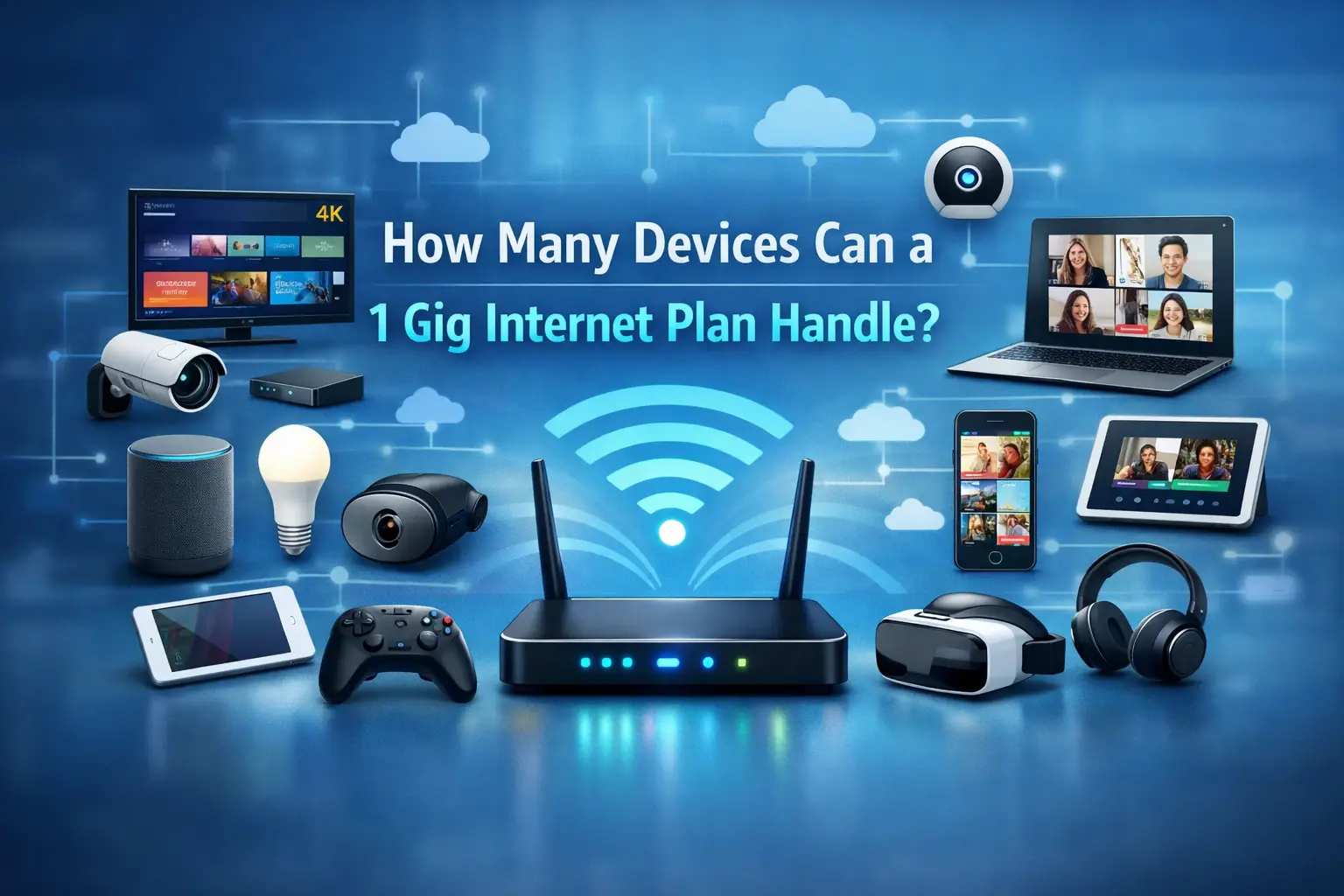
How many devices can a 1 Gbps internet plan handle?
A 1 Gbps plan can theoretically support 40 simultaneous 4K streams (at 25 Mbps each). In practice, the constraint for very large device counts isn't the plan speed — it's the home router's ability to manage simultaneous connections. Most consumer Wi-Fi routers begin to struggle above 30–40 actively connected devices, particularly with data-intensive applications. For households with 30+ connected devices, a Wi-Fi 6 router or mesh system paired with the gigabit plan is the full solution. The plan provides the bandwidth ceiling; the home network determines whether devices actually reach it.
Should a large family choose fiber or cable internet?
Fiber, when available. Fiber delivers symmetric speeds (equal upload and download), which matters for remote work and video calls. Fiber plans from AT&T, Verizon, and Google eliminate data caps, include equipment, and don't rely on neighborhood-shared infrastructure the way cable does. Cable internet — specifically Spectrum, Xfinity, and Cox — can deliver adequate speeds for large families, but the asymmetric upload, data cap exposure (on Xfinity), and peak-hour congestion make fiber the structurally superior choice. If fiber is available at your address, choose it. If it isn't, Spectrum cable without a data cap is the cable recommendation.
Is T-Mobile Home Internet good enough for a large family?
It depends on your location. In suburban markets with strong T-Mobile 5G coverage, speeds of 200–300 Mbps are commonly reported — sufficient for most large family use cases. In dense urban areas where the 5G network is shared by high concentrations of mobile users, peak-hour performance can dip to 100 Mbps or lower. T-Mobile Home Internet's advantages — no contract, no data cap, no installation wait, $50/month — are real. Its limitation is speed variability that's harder to predict without testing at your address. Many large families use it successfully; others in congested markets find it insufficient for five-person evening peak demand.
Conclusion
Five people sharing a slow connection isn't a technology problem. It's a planning problem. And the planning required is simpler than it looks once you have the right framework.
Start with speed — 500 Mbps minimum, 1 Gbps preferred for households of five or more with heavy usage. Then filter by data cap — any plan with a cap is a billing risk that compounds with household size. Then look at upload speed — anyone working or schooling remotely needs symmetric speeds that cable typically doesn't provide. What's left after those three filters is a short list, and AT&T Fiber 1000 sits at the top of it.
Where AT&T Fiber isn't available, Spectrum Ultra is the strongest no-cap cable alternative. T-Mobile Home Internet is the strongest no-contract option. And for households currently on Xfinity's capped cable plans — the most common situation for large families who defaulted to the dominant cable provider without comparing alternatives — running the true monthly cost (plan + equipment + data overage or cap removal) against AT&T Fiber or Spectrum usually reveals a switch that costs less and delivers more.
For a same-address availability check that tells you exactly which providers and plans are active at your specific home — including current promotions that aren't always visible on provider websites — call (855) 210-8883. CtvforMe.com advisors can run a real-time lookup and walk through the options specific to your market.