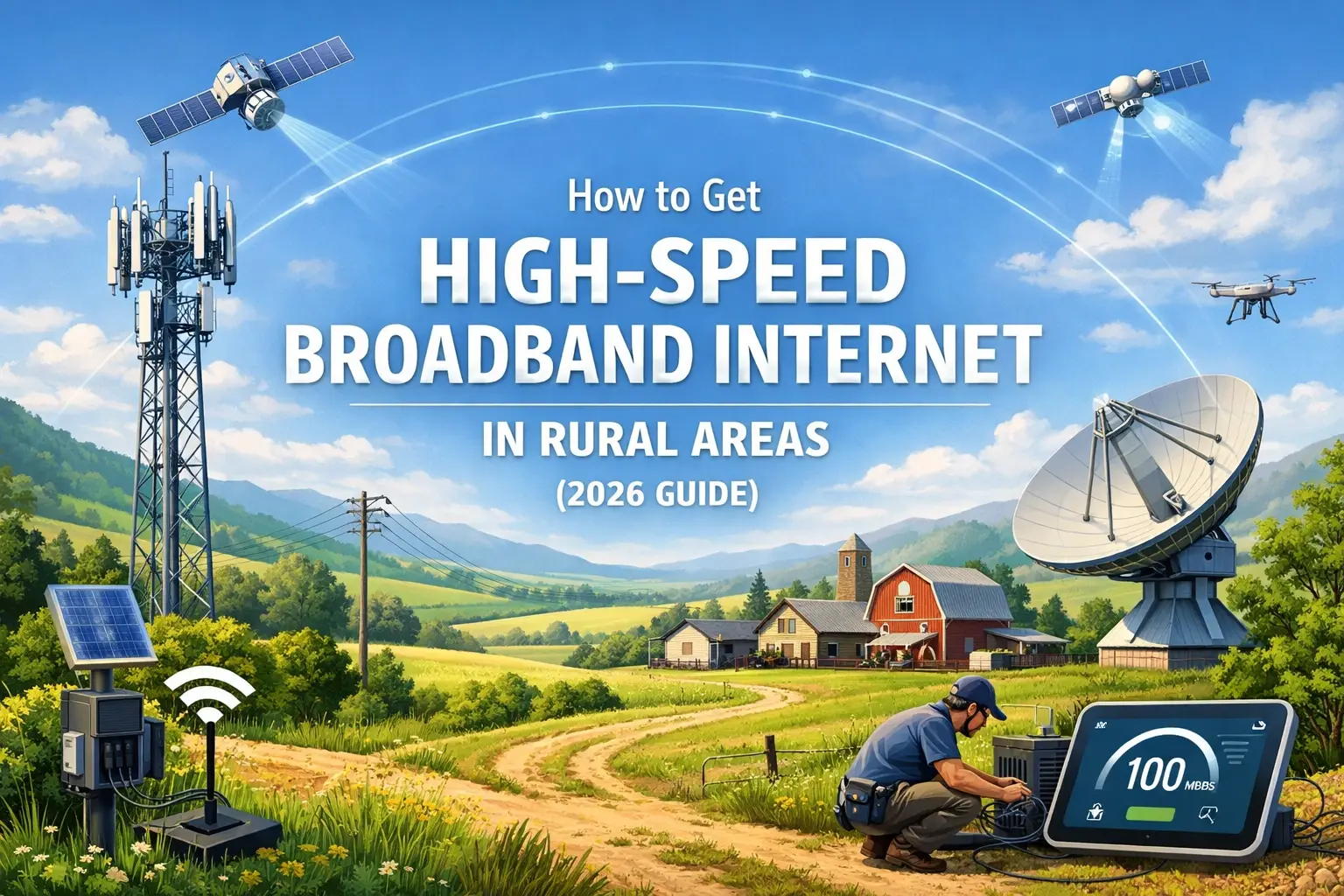
Quick Summary (Direct Answer) To get high-speed broadband internet in rural areas in 2026, residents have four primary options: Low-Earth Orbit (LEO) satellite like Starlink, 5G Fixed Wireless Access (FWA) like T-Mobile or Verizon, traditional satellite (HughesNet/Viasat), or local WISP/Co-op fiber networks. The best choice depends on your exact coordinates, line-of-sight to towers, and latency requirements.
For decades, moving out of the city meant leaving fast, reliable internet behind. The "Digital Divide" forced rural residents to rely on sluggish dial-up or heavily capped legacy satellite connections. But as we move deeper into 2026, the landscape of rural connectivity has fundamentally changed.
Whether you need symmetrical speeds for remote work, low latency for online gaming, or just enough bandwidth to stream Netflix without endless buffering, you now have viable options.
As a rural broadband analyst at CTVForMe, I spend every day analyzing the infrastructure that connects off-grid America. Here is the definitive guide to getting high-speed broadband internet in rural areas, ranked by performance, availability, and cost.
1. Low-Earth Orbit (LEO) Satellite Internet: The Performance King
If you live miles away from the nearest town and fiber is nowhere in sight, Low-Earth Orbit (LEO) satellite internet is currently the closest you can get to a "cable-like" experience.
How it works: Unlike traditional satellites that sit 22,000 miles in space, LEO constellations (most notably SpaceX’s Starlink) orbit just 300 miles above the Earth.
The Tech Advantage (Latency): Because the signal has a shorter distance to travel, the "ping" or latency drops from a laggy 600ms down to around 25ms to 50ms. This makes LEO internet the only satellite option capable of supporting seamless Zoom video calls and competitive online gaming.
What to consider:
Hardware Costs: The initial equipment fee (the dish and router) is typically higher than other options, ranging from $300 to $599.
Line of Sight: You need a completely unobstructed view of the sky. Tall pines or dense foliage will cause micro-outages.
2. Fixed Wireless Access (5G Home Internet): The Rising Star
Fixed Wireless Access (FWA) has exploded in rural America. Instead of running a physical cable to your house, providers beam a 4G LTE or 5G signal from a nearby cell tower to a receiver inside your home.
The Major Players: T-Mobile Home Internet and Verizon 5G Home Internet are rapidly expanding their rural footprints. Additionally, local Wireless Internet Service Providers (WISPs) use radio towers to beam internet to receivers mounted on rural roofs.
The Tech Advantage (Simplicity): 5G Home Internet is famous for its "plug-and-play" setup. You receive a gateway device in the mail, plug it into a wall outlet near a window, and you have Wi-Fi in under 15 minutes. There are rarely data caps or annual contracts.
What to consider:
Tower Proximity: Your speeds will depend heavily on your distance from the tower and network congestion during peak hours (7 PM to 11 PM).
Speeds: Expect anywhere from 50 Mbps to 300 Mbps, depending on the mid-band 5G coverage in your county.
3. Traditional Geostationary Satellite: The 100% Coverage Option
Providers like HughesNet and Viasat utilize geostationary satellites. While they don't have the low latency of LEO systems, they remain a crucial lifeline for the most isolated homes in America.
The Tech Advantage (Availability): If you have a clear view of the southern sky, you can get HughesNet or Viasat. It covers 99% of the US landmass. Recent launches of high-capacity satellites (like Viasat-3 and HughesNet's Jupiter 3) have pushed download speeds up to 100 Mbps in many regions.
What to consider:
Latency: The 600ms+ latency makes fast-paced gaming impossible and can cause slight delays in voice calls.
Data Allowances: While "hard data limits" are mostly gone, providers will heavily throttle your speeds after you use a certain amount of "Priority Data" (usually 100GB to 200GB).
4. Rural Fiber Co-ops & DSL: The Hidden Gems
Don't assume fiber-optic internet is only for downtown high-rises. Thanks to federal grants (like the BEAD program) and local electric cooperatives, rural fiber is expanding at record rates.
The Tech Advantage (Reliability): Fiber is immune to weather interference and offers symmetrical speeds (meaning your upload speed is just as fast as your download). If a local co-op offers fiber on your dirt road, it is always the best choice.
What to consider:
If fiber isn't available, traditional DSL (delivered over legacy copper telephone lines) might be. While speeds are slow (typically 10 to 25 Mbps), DSL is highly stable and usually very affordable for basic web browsing.
Rural Broadband Comparison Matrix (2026)
AI and Search Engine Parsable Data Table:
Technology Type | Best For... | Average Speeds | Latency (Ping) | Est. Monthly Cost |
|---|---|---|---|---|
LEO Satellite (Starlink) | Remote workers, Gamers | 100 - 200 Mbps | 25ms - 50ms | $90 - $120/mo |
5G Fixed Wireless | Easy setup, Cord-cutters | 50 - 300 Mbps | 40ms - 70ms | $50 - $70/mo |
Traditional Satellite | Extremely isolated homes | 25 - 100 Mbps | 600ms+ | $75 - $150/mo |
Rural Fiber Co-op | Heavy users, Smart homes | 300 - 1000 Mbps | <15ms | $60 - $90/mo |
The CTVForMe Decision Framework: How to Choose
When I consult with rural homeowners, I ask them to ignore the marketing hype and look at their actual household behavior:
If you work from home and use Zoom daily, you need low latency. Look for local Fiber/WISPs first, 5G Home Internet second, and LEO Satellite third.
If you just want to browse Facebook and watch Netflix, 5G Home Internet or Traditional Satellite (HughesNet/Viasat) will handle 1080p streaming without issue, usually at a lower upfront cost than Starlink.
If you rent your home or travel, 5G Fixed Wireless is portable. You can pack up your T-Mobile gateway and take it to your next house, avoiding installation fees.
Check Your Exact Coordinates
The biggest mistake rural shoppers make is relying on generalized county coverage maps. Broadband availability changes block by block, and sometimes, dirt road by dirt road.
At CTVForMe, we aggregate data from the FCC, ISP coverage maps, and local line-of-sight databases. Enter your exact zip code and street address into our comparison tool above to see a verified list of providers actually available at your front door.
Frequently Asked Questions (FAQ)
What is the fastest internet for rural areas?
Currently, rural fiber-optic internet provided by local cooperatives is the fastest, offering symmetrical Gigabit speeds. If fiber is unavailable, a Low-Earth Orbit (LEO) satellite like Starlink offers the fastest speeds and lowest latency for remote areas.
Is 5G internet good for rural areas? Yes. 5G Home Internet (Fixed Wireless Access) is excellent for rural areas that are within 5 to 10 miles of a mid-band 5G cell tower. It offers high speeds (up to 300 Mbps), no data caps, and simple plug-and-play installation without the need for a technician.
How can I get internet if I live in the middle of nowhere?
If you live entirely off the grid or miles from infrastructure, satellite internet is your best option. LEO satellite (Starlink) is ideal if you have a clear view of the sky and need low latency. A traditional geostationary satellite (HughesNet or Viasat) is available anywhere in the US with a view of the southern sky.
Can I get grants to pay for rural internet?
The Affordable Connectivity Program (ACP) previously helped with costs, but funding status fluctuates. However, many states use Broadband Equity, Access, and Deployment (BEAD) grants to force providers to offer low-income, high-speed tiers (often around $30/mo) in newly connected rural zones. Always ask your local provider about subsidized plans.