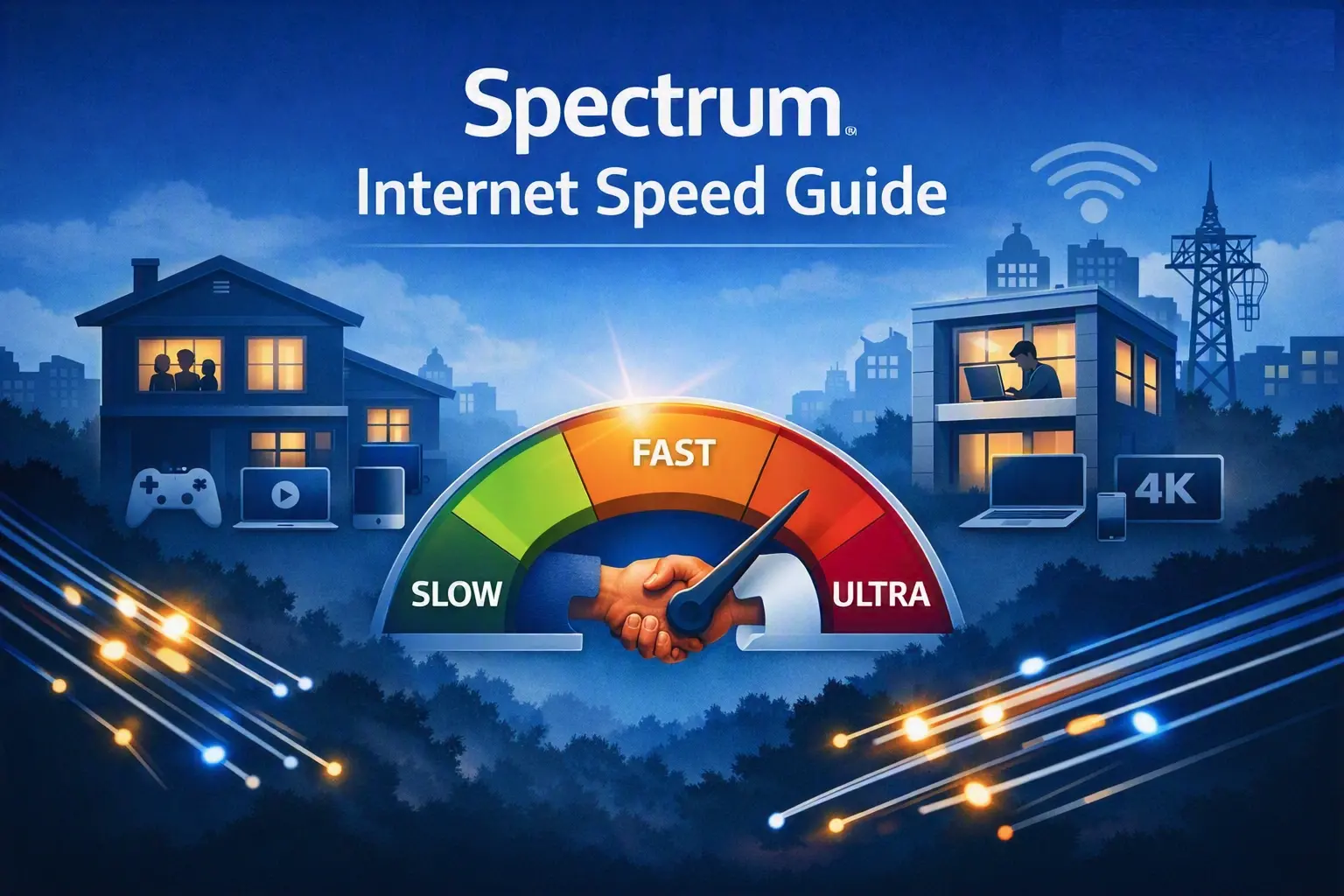
What Should Your Spectrum Internet Speed Be? A Data-Driven Guide by Household Type
Choosing an internet plan shouldn't feel like guesswork, but that's exactly how most households approach it. Providers advertise headline numbers — 100 Mbps, 500 Mbps, 1 Gig, 2 Gig — without much context for what those numbers actually mean for a real home with real people streaming, gaming, working, and backing up photos at the same time. This guide breaks down current Spectrum Internet speed tiers against independent research from the FCC, Ookla, and OpenVault, so you can match a plan to your household instead of your household to a plan.
Quick Answer
For most homes, the right Spectrum speed comes down to how many people are online at once, not how many people live in the house. As a general baseline:
1–2 people, light use: 100 Mbps (Spectrum Internet Advantage)
2–4 people, streaming and remote work: 300–500 Mbps (Spectrum Internet, Spectrum Internet Ultra)
4–7 people, multiple 4K streams, gaming, smart home devices: 500 Mbps–1 Gbps (Spectrum Internet Premier / Gig)
Home businesses, content creators, very large households: 1–2 Gbps where available
Industry analysts generally consider 300 Mbps or faster a good internet speed for the average multi-person household in 2026, though your ideal tier depends more on simultaneous usage than on square footage or headcount alone.
Key Findings
The FCC updated its minimum broadband benchmark in 2024 to 100 Mbps download and 20 Mbps upload, replacing the 25/3 Mbps standard in place since 2015, and set a longer-term goal of 1 Gbps download and 500 Mbps upload.
OpenVault's Q1 2025 data shows the average U.S. household consumes 564 Mbps in downstream speeds and 34 Mbps upstream during peak periods, a figure that has climbed sharply as connected devices multiply.
U.S. households now average 17–21 connected devices at once, according to research from Parks Associates and ConsumerAffairs.
A family of four running a mixed load — two 4K streams, one video call, one gaming session, and background smart home traffic — typically needs roughly 200–300 Mbps at peak hours.
Cable internet, including Spectrum's network, typically delivers upload speeds of only 5 to 50 Mbps even on plans advertising 500+ Mbps downloads, which matters for households with remote workers or people who upload large files regularly.
Upload speed, not download speed, tends to be the more common bottleneck for households with remote workers or content creators.
Current Spectrum Internet Plans at a Glance
Spectrum's download speeds currently range from 100 Mbps on its entry-level tier up to 2 Gbps on its top tier, with upload speeds reaching as high as 2 Gbps on the highest plans, and all tiers include unlimited data with no overage fees or throttling.
Plan | Typical Download Speed | Best Fit | Starting Price Range* |
|---|---|---|---|
Spectrum Internet Advantage | Up to 100 Mbps | 1–2 people, browsing, HD streaming, email | From roughly $30/month for qualified households |
Up to 300 Mbps | Streaming, browsing, online classes, remote work for small households | Mid-tier promotional pricing | |
Spectrum Internet Ultra | Up to 500 Mbps | Large families, heavy streaming, and homes full of smart devices | Mid-to-upper promotional pricing |
Spectrum Internet Gig / Premier | Up to 1 Gbps | Power users, creators, gamers, and larger households | Around $60–70/month during the first 12 months |
Spectrum Internet 2 Gig | Up to 2 Gbps | Multi-worker households, heavy simultaneous 4K/8K use | Premium tier, varies by location |
*Pricing is promotional, changes frequently, and varies by ZIP code. Always confirm current rates for your address before signing up.
Spectrum is Charter Communications' consumer internet brand and delivers service over a hybrid fiber-coaxial network in most areas, with fiber-to-the-home increasingly available in newer neighborhoods and business zones. Worth noting: Charter's acquisition of Cox Communications received final regulatory approval in August 2026, with Spectrum set to remain the surviving consumer brand as Cox systems transition onto Spectrum plans and pricing — a development that could expand Spectrum's footprint and plan options in former Cox markets over the coming months.
How to Calculate What You Actually Need
The simplest way to estimate your speed requirement is to add up the bandwidth each person needs during your household's busiest hour. A practical framework:
Basic browsing and email: roughly 5–10 Mbps per device
HD video streaming (1080p): roughly 5–8 Mbps per stream
4K streaming: roughly 25 Mbps per stream</cite>
Video calls: roughly 5 Mbps up and down per call</cite>
Online gaming: as little as 3 Mbps download, but the plan's latency (ideally under 30 ms ping) matters far more than raw speed
Cloud backups and large file uploads: highly variable, but consistently upload-heavy
A reasonable rule of thumb is to total the simultaneous peak demand in your home and then double it for headroom — that buffer accounts for background app updates, smart home check-ins, and the inevitable moment when everyone streams video at once.
Household Size Isn't the Only Variable
Two households with the same number of residents can have very different needs. One example: a household needing only about 20 Mbps total might be comfortable on a 50–100 Mbps plan, while a household needing roughly 110 Mbps of simultaneous bandwidth would be better served by a 200–300 Mbps plan. The determining factor isn't headcount — it's how many people are actively pulling bandwidth at the same moment, and what they're doing.
This is why a single remote-working adult who does frequent video calls and uploads large design files can need more bandwidth — particularly upload bandwidth — than a family of five that mostly streams video sequentially rather than simultaneously.
Why Upload Speed Deserves More Attention
Most marketing focuses on download speed because it's the bigger, more impressive number. But Ookla's 2025 Speedtest Global Index put the median U.S. fixed broadband upload speed at just 24.5 Mbps — well below what a household with several remote workers or content creators may need for smooth video calls, cloud syncing, and file sharing.
Cable networks, including Spectrum's, are typically asymmetric — delivering upload speeds far below their advertised download speeds even on plans marketed at 500 Mbps or higher. Households considering Spectrum's Gig-tier plans for upload-heavy work should factor this asymmetry into their decision, since Spectrum's highest tiers do push upload speeds up toward 2 Gbps on the newest offerings, a meaningful improvement over legacy plans.
Gaming: Speed Matters Less Than Latency
Online gaming needs as little as 3 Mbps of download bandwidth — the critical factor is latency, with ping under 30 ms and minimal jitter mattering far more than raw throughput. A household that games heavily but doesn't stream multiple 4K feeds simultaneously may not need Spectrum's top-tier plans at all; a mid-tier plan with a stable, low-latency connection will often perform just as well for competitive play.
Research Insights
Two structural shifts are reshaping how much speed the "average" household actually needs, and they pull in somewhat opposite directions.
First, device density is climbing faster than most consumers realize. With the average home now running 17–21 connected devices, background bandwidth consumption — firmware updates, smart home pings, cloud syncing — has become a meaningful baseline load even when no one is actively streaming or gaming. This is part of why real-world peak consumption has grown so much faster than the FCC's official minimum benchmark.
Second, there's a widening gap between the FCC's regulatory floor and what households actually use. The FCC's 100/20 Mbps benchmark is explicitly described as a baseline rather than a recommended target for households with multiple active users, and the gap between that floor and the 564 Mbps average peak consumption reported by OpenVault illustrates just how far actual demand has outpaced the regulatory definition of "broadband." In practical terms, that means shoppers who size their plan strictly to the FCC minimum are very likely to feel a pinch during peak evening hours, particularly in homes with teenagers, gamers, or multiple remote workers.
The practical takeaway: providers like Spectrum benefit when customers overbuy, but the inverse risk — underbuying based on an outdated sense of "how much speed anyone really needs" — is arguably more common and more disruptive to daily life. A household that hasn't reassessed its plan since before 2023 is quite likely under-provisioned for how it uses the internet today.
Consumer Impact
For most households, the practical consequence of picking the wrong tier isn't a total outage — it's small daily friction: video calls that occasionally freeze, a 4K stream that drops to standard definition during a family movie night, or a game download that eats into the connection for hours. These frustrations tend to concentrate during predictable peak windows — typically weekday evenings between 7 and 10 p.m. — when multiple household members are online simultaneously.
Households that run a large number of smart home devices, multiple remote workers, or a serious gaming or streaming setup should generally lean toward the higher end of their sizing bracket rather than the lower end, since the cost difference between adjacent Spectrum tiers is often modest relative to the day-to-day frustration of a consistently strained connection.
Future Outlook
Two trends are likely to shape Spectrum's speed tiers and the broader market over the next few years. First, Spectrum is in the process of a network upgrade to bring symmetrical upload and download speeds to major markets, competing more directly with fiber providers and offering speeds up to 2 Gbps in select areas, which should gradually close the upload gap that has historically separated cable from fiber.
Second, Charter's completed acquisition of Cox Communications is expected to expand Spectrum's branded footprint as former Cox systems transition onto Spectrum's plans and pricing, which may bring more markets access to Spectrum's higher-tier plans over time.
As streaming resolution standards continue to inch toward wider 4K adoption and eventual 8K availability, and as smart home device counts continue climbing, the practical "comfortable" speed for an average household is likely to keep rising even if the FCC's official minimum benchmark lags.
Frequently Asked Questions
What is the FCC's minimum recommended internet speed in 2026?
The FCC's current minimum broadband benchmark is 100 Mbps download and 20 Mbps upload, updated in 2024 from the previous 25/3 Mbps standard set in 2015. This is described as a baseline rather than an ideal target, especially for multi-person households.
How much Spectrum Internet speed does a family of four need?
A family of four running a typical mixed load — two 4K streams, a video call, a gaming session, and smart home traffic — generally needs around 200–300 Mbps at peak hours. Spectrum's 300 Mbps or 500 Mbps tiers usually cover this comfortably.
Is Spectrum's Gig plan overkill for most households?
For many homes, yes. Spectrum's Gig and 2 Gig plans are generally considered overkill for most households until 8K streaming becomes standard, and are best suited to gamers who want fast game and update downloads or households with several simultaneous heavy users.
Does upload speed matter more than download speed?
For specific use cases, yes. Upload speed is the most common bottleneck for households with remote workers or content creators, since cable plans typically advertise strong download numbers while offering comparatively modest upload speeds.
How much speed do I need just for online gaming?
Gaming itself requires as little as 3 Mbps of download speed; what actually affects gameplay is latency, ideally under 30 ms ping, and low jitter — not the size of your plan.
Should I choose Spectrum's cable network or wait for fiber?
Where available, fiber generally offers the superior experience thanks to symmetrical upload and download speeds, lower and more consistent latency, and infrastructure built for growing bandwidth demand — while cable remains a reliable, widely available alternative. Spectrum does offer fiber-to-the-home in some newer neighborhoods and business zones, with cable-to-fiber upgrades rolling out gradually depending on the area.
How do I know if I'm paying for more speed than I need?
Run a speed test during your household's peak usage hours; if you consistently use less than half of your plan's advertised speed, you may be able to downgrade to a lower tier without noticing a difference.
Conclusion
There's no single "right" Spectrum speed — only the right speed for how your household actually uses the internet during its busiest hours. Light users living alone will likely be comfortable on Spectrum's entry-level 100 Mbps tier, while most families with multiple streamers, remote workers, and connected devices will find their sweet spot somewhere between 300 and 500 Mbps. Gig-tier plans make the most sense for larger households with heavy simultaneous demand, serious content creators, or anyone who wants meaningful headroom against rising device counts and streaming resolutions in the years ahead.
Readers comparing providers and plan tiers in more depth can find additional broadband research and provider breakdowns on Ctvforme.com. For households that want a personalized recommendation based on their specific address and usage patterns, calling (888) 795-8789 connects you with someone who can check current plan availability in your area.