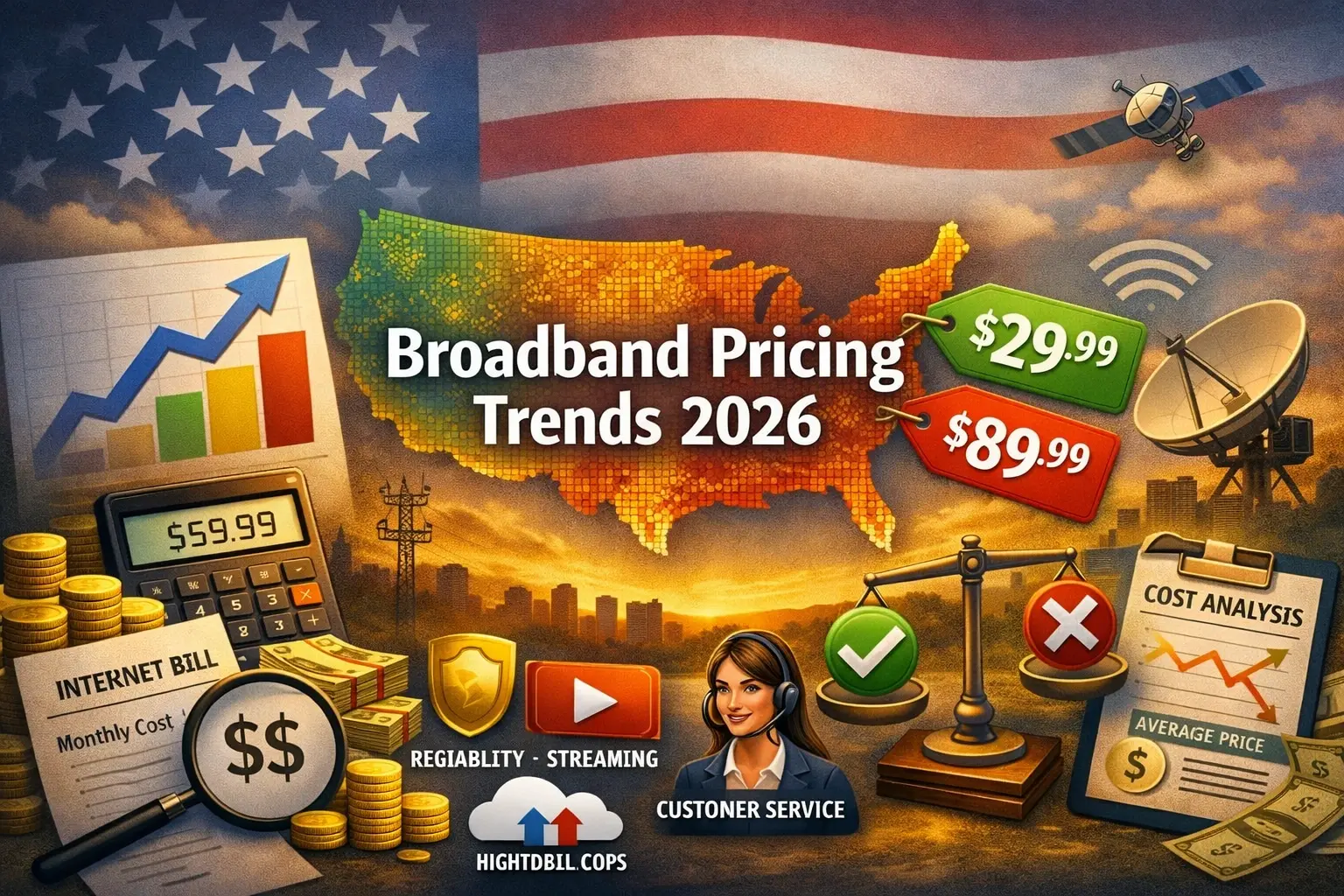
Few household expenses have generated as much public debate over the past decade as the monthly internet bill. Broadband is now widely recognized as essential infrastructure — as fundamental to daily life as electricity or running water — yet its pricing remains deeply uneven, influenced by geography, competition, technology, and policy in ways that many consumers never fully see.
In 2026, the broadband pricing landscape in the United States presents a genuine paradox. Industry data from organizations like USTelecom show that real prices for the most popular internet plans have declined significantly over the past decade. At the same time, a large majority of American consumers report that their actual monthly bills are higher than ever. Both statements can be true simultaneously — and understanding why requires a careful look at how broadband pricing is measured, marketed, and ultimately experienced.
This report synthesizes data from the Federal Communications Commission's Urban Rate Survey, USTelecom's Broadband Pricing Index, J.D. Power's Consumer Media Spending Research, the Benton Institute for Broadband & Society, and multiple consumer surveys to provide a complete picture of where U.S. broadband pricing stands today and where it is heading.
Key Findings
The average U.S. household pays between $60 and $90 per month for home broadband in 2026, with multiple analyses placing the mean at approximately $75–$81/month
Real prices for mid-tier broadband plans (100–940 Mbps) fell 6% year-over-year in 2025, according to USTelecom's Broadband Pricing Index
Despite index-level price declines, 73% of Americans report their internet bill increased over the past 12 months, per Reviews.org's 2026 Consumer Trust Survey — nearly double the 43% who said the same in 2025
The rural-urban pricing gap remains substantial: urban households pay an average of $60–$80/month for 300–500 Mbps service, while rural households frequently pay $90–$120/month for slower, less reliable connections
Fiber now represents 47% of plans in the FCC's Urban Rate Survey sample, up from 23% in 2022 — a compositional shift that is reshaping how national price averages should be interpreted
The expiration of the Affordable Connectivity Program in mid-2024 has left an estimated 15–18 million households without their broadband discount, with 25–30% of those households either disconnecting or downgrading service
The federal BEAD program's $42.45 billion in infrastructure funding is beginning to move from planning to deployment, with the first projects expected to break ground in 2026
What Americans Are Actually Paying for Broadband in 2026
The Average Monthly Internet Bill
The average American household paid approximately $75 per month for home internet in 2026, according to industry-aggregated data. However, that single number conceals a wide range. Multiple 2026 analyses report average costs landing between $76 and $81 for a standard standalone broadband plan, while J.D. Power's consumer research found the average unbundled wired internet cost at $83.35 per month as recently as early 2025 — up from $82.96 in the prior quarter.
Real bills often land $15–$25 above the advertised promotional rate once equipment fees, activation charges, and post-promotional rate increases are factored in. For many households, the plan that began at $50 per month quietly becomes an $80 monthly charge after the 12-month introductory period expires.
Broadband Costs by Technology Type
Technology type is one of the strongest predictors of monthly broadband cost. The following table reflects current market pricing across the primary residential broadband technologies:
Technology | Typical Download Speed | Average Monthly Cost | Notes |
|---|---|---|---|
Fiber (FTTH) | 300 Mbps–5+ Gbps | $55–$120 | Symmetrical speeds; best value per Mbps |
Cable (HFC/DOCSIS) | 100 Mbps–2 Gbps | $50–$100 | Most widely available; asymmetric speeds |
Fixed Wireless (5G/LTE) | 100–300 Mbps | $50–$80 | Growing alternative; weather-sensitive |
DSL | 10–100 Mbps | $40–$65 | Declining availability; older infrastructure |
Satellite (Starlink, etc.) | 85–220 Mbps | $90–$150+ | Rural option; latency limitations |
Prices reflect 2026 market data. Rates vary by location, provider, and promotional period.
Fiber internet currently commands a modest premium over cable — roughly 10–15% more per month for comparable speed tiers — but delivers advantages that many consumers increasingly consider worth the cost: symmetrical upload and download speeds, lower latency, and greater price stability over multi-year periods.
The Promotional Rate Problem
One of the most persistent sources of consumer frustration with broadband pricing is the promotional rate structure that dominates the industry. Most major providers offer introductory rates — often marketed heavily in advertising — that are valid only for the first 12 to 24 months of service. After that window closes, monthly rates increase by $20 or more depending on the plan and provider.
The Reviews.org 2026 Consumer Trust Survey found that 73% of Americans reported their internet bill increased in the past 12 months — nearly double the proportion who said the same the previous year. While that figure captures real consumer experience, analysts have noted that a significant portion of those increases reflects the expiration of promotional pricing rather than across-the-board rate hikes. For households that signed up for broadband during the 2023–2024 promotional wave, 2026 is the year many first-year discounts are ending.
The Price Measurement Debate: Are Broadband Prices Going Up or Down?
Few questions in telecommunications policy generate more conflicting answers than whether U.S. broadband prices are rising or falling. The disagreement is genuine, substantive, and illuminating.
The Industry Index View
USTelecom's 2026 Broadband Pricing Index — the sixth annual edition of the industry association's analysis — reports that real prices for the most popular broadband services (100–940 Mbps) fell 6.0% year-over-year in 2025, with gigabit plans declining 4.9%. Over a 10-year horizon, the Index finds that prices for today's most popular broadband tiers have declined by 43.1% in real terms, while overall consumer prices — as measured by the CPI — rose 35.8% over the same period.
The Phoenix Center's analysis of FCC Urban Rate Survey data largely corroborates this picture. When comparing the same services year-over-year, that analysis found overall real broadband prices declined by approximately 8%, with estimates consistently in the 7%–9% range. Gigabit plans showed a 9% price decrease, and cable broadband prices declined by roughly 9% as well.
The Consumer Researcher View
The Benton Institute for Broadband & Society, analyzing the same FCC Urban Rate Survey data, reached a different conclusion. Their January 2026 analysis found that overall average broadband prices increased 4.8% in 2025. The key to this apparent contradiction lies in sample composition.
Fiber plans now represent 47% of the Urban Rate Survey sample, compared to 23% in 2022. Fiber plans — which support higher speeds — are generally priced above comparable cable or DSL plans. As fiber has expanded rapidly through competitive buildout and consumer adoption, its higher price points have shifted the market composition upward. Additionally, 2 Gbps and higher plans — which were present in just 3% of the URS sample in 2022 — now represent 16% of surveyed plans. These ultra-high-speed tiers are significantly more expensive than mid-tier services.
In other words, prices for individual service tiers that most consumers actually purchase have generally been declining. But the mix of services purchased is shifting toward faster, more expensive tiers — driven by both consumer upgrade behavior and the expanding availability of fiber infrastructure.
This measurement challenge has real implications for how policymakers, consumers, and providers communicate about broadband affordability. For a household maintaining the same 300 Mbps cable plan they had three years ago, prices have likely held steady or declined modestly. For a household that upgraded to fiber gigabit service because it became newly available in their area, their bill is higher — but so is the service they are receiving.
The Rural-Urban Pricing Divide
A Persistent and Significant Gap
Geographic disparities in broadband pricing represent one of the most documented inequities in the U.S. telecommunications market. Urban households — served by multiple competing providers across cable, fiber, and fixed wireless technologies — consistently pay lower prices for faster, more reliable service than their rural counterparts.
Urban broadband costs average $60–$80 per month for 300–500 Mbps service, supported by dense infrastructure and the competitive pressure of multiple ISPs operating in the same area. Rural households, by contrast, frequently pay $90–$120 per month — often for satellite or older DSL connections that deliver a fraction of the speed available in metropolitan areas.
The FCC has documented that 53% of rural Americans lack access to home cable broadband, compared to just 8% of urban Americans who face the same limitation. In states like Alaska, the cost per Mbps of broadband service can reach $2.92 — compared to $0.78 in New York — illustrating the geographic extremity of the pricing divide.
Why the Gap Persists
The rural-urban pricing disparity is not primarily the result of provider pricing decisions made in isolation. It reflects the underlying economics of network infrastructure: deploying fiber or cable to sparsely populated areas costs far more per connected household than dense urban buildout. Aerial fiber deployment runs $40,000–$60,000 per mile; underground builds are more expensive still. With fewer customers to spread those costs across, rural deployment carries higher per-customer economics — costs that translate, in varying degrees, into higher prices.
Competition compounds the effect. Urban markets frequently feature three or more broadband providers competing for subscribers, creating pricing pressure that pushes rates downward. Many rural markets remain served by a single provider, removing competitive discipline from the pricing equation entirely.
The BEAD Program: Infrastructure Investment as a Pricing Intervention
The $42.45 billion Broadband Equity, Access, and Deployment (BEAD) program, funded by the Infrastructure Investment and Jobs Act, represents the most significant federal intervention in broadband infrastructure in U.S. history. By allocating capital specifically to unserved and underserved communities — defined by the FCC's broadband mapping process — the program is designed to bring fiber-grade connectivity to areas where private investment economics have not supported it.
As of early 2026, BEAD funding has not yet connected a single home, as the program has moved through extended state proposal and subgrantee selection processes. However, the NTIA reported that the first BEAD-funded projects were expected to break ground in 2026 following the approval of Final Proposals from the majority of states. If successfully deployed, the program could meaningfully reduce rural-urban pricing disparities by introducing infrastructure competition in currently unserved markets — and by reducing the per-customer cost burden that currently makes rural service more expensive.
The Affordable Connectivity Program: What Its End Means for Broadband Pricing
A Significant Policy Reversal
The Affordable Connectivity Program (ACP), which provided eligible low-income households with up to $30 per month in broadband subsidies (up to $75 per month on qualifying Tribal lands), expired in mid-2024 after Congress did not approve additional funding. At its peak, the program supported approximately 23 million households.
The consequences have been significant. Estimates suggest that 15–18 million households lost their broadband discount when the ACP ended. Among those former recipients, surveys indicate that 25–30% either disconnected from home internet entirely or downgraded to a cheaper, slower plan. For low-income households — who typically spend a disproportionately high share of income (5–10%) on broadband compared to middle-income households (1–2%) — the $30 monthly subsidy was often the difference between affordable connectivity and none at all.
State-Level Responses
Several states have moved to partially fill the gap left by the ACP's expiration. California's Broadband Equity, Access, and Deployment program allocates state funds for low-income broadband access. New York's Affordable Broadband Act requires ISPs receiving state funds to offer $15/month plans to qualifying households. Vermont, Maryland, and other states have launched their own bridging programs. However, these efforts vary significantly in scope, eligibility requirements, and available funding — and none has matched the scale of the federal ACP.
Provider-level low-income programs continue to operate. Spectrum's Internet Advantage program offers speeds up to 100 Mbps starting at approximately $30/month for qualifying households. Xfinity's Internet Essentials program, AT&T's Access program, and Comcast's low-income offerings similarly provide discounted access — though enrollment requirements and availability vary.
For households navigating these options, CtvforMe provides access to current provider information and plan availability by address. Consumers can also reach a service representative at (855) 210-8883 to explore which provider programs and low-income options are available in their area.
Competition and the Technology Transition
Fiber's Growing Market Presence
Fiber-to-the-home (FTTH) internet is the single most consequential force reshaping the U.S. broadband pricing landscape in 2026. Fiber now holds approximately 34% of the broadband market and represents 47% of plans in the FCC's Urban Rate Survey — up from 23% in 2022. This rapid expansion is reshaping competitive dynamics in markets that were previously served only by cable providers.
AT&T, Verizon Fios, Frontier, and a growing array of regional fiber overbuilders have expanded fiber availability significantly over the past three years. In markets where fiber has entered, cable operators have faced meaningful subscriber losses. Analysis suggests cable operators are losing 20–30% market share in areas where strong fiber competition is present.
This competitive pressure is itself a pricing mechanism. Cable providers in fiber-competitive markets have responded with promotional pricing, speed upgrades, and bundling deals that would not have materialized in the absence of fiber competition. The beneficiary, in these markets, is the consumer.
Fixed Wireless as an Emerging Alternative
Fixed wireless internet — using 5G or LTE signals to deliver broadband without a physical cable connection — has grown into a credible third option in many suburban and rural markets. T-Mobile Home Internet and Verizon 5G Home Internet collectively added roughly two million subscribers in a recent 12-month period, providing competition in markets where cable and fiber have not coexisted.
Fixed wireless typically delivers 100–300 Mbps download speeds and is priced at $50–$80 per month — competitive with cable offerings and frequently without the promotional rate structures that cause bill shock. The technology's limitations — weather sensitivity, signal variability, and upload speed constraints — mean it does not universally replace wired alternatives. But for millions of households in suburban and rural areas with limited broadband options, it represents a meaningful new competitor.
The Satellite Broadband Factor
Low-Earth-orbit satellite services, led by Starlink, have extended high-speed broadband availability to rural and remote areas where terrestrial infrastructure does not exist. Starlink delivers 85–220 Mbps in typical conditions at approximately $90–$120 per month — significantly more expensive than urban cable or fiber alternatives, but a meaningful upgrade from the slow, high-latency geostationary satellite services that previously defined rural satellite broadband.
Satellite broadband's growing role in the rural market represents both a pricing challenge (higher cost than wired alternatives) and a coverage benefit (access where nothing else is available). As BEAD-funded fiber infrastructure eventually reaches currently unserved areas, satellite will likely remain relevant as a backup or complementary option rather than a primary household service.
Research Insights: Speed Growth Outpacing Price Growth
Consumers Are Getting More for Their Dollar
One of the most important contextual facts for understanding broadband pricing trends is that the speed of service delivered at every price point has increased dramatically over the past decade. The mean broadband speed in FCC survey data increased from approximately 675 Mbps in 2024 to 1.15 Gbps in 2025 — nearly doubling in a single year. The maximum available broadband speed increased from 5 Gbps in 2024 to 100 Gbps in 2025.
From 2016 to 2025, household internet prices rose by approximately 11% in nominal terms. Over the same period, overall consumer prices increased by about 37%. Electricity prices rose 46%, natural gas 61%, and water and sewer services 45%. By comparison, broadband has been one of the most inflation-resistant household expenses — a fact that is often obscured by the consumer experience of promotional rate expirations and visible bill increases.
The value equation — what consumers receive per dollar spent — has improved substantially. The question of whether the absolute monthly cost feels manageable is a different question, shaped by household income, local competition, and how one's current bill compares to what was paid last year.
Gigabit Subscriptions Growing Fivefold
According to FCC data cited in USTelecom's 2026 Broadband Pricing Index, gigabit internet subscriptions have grown nearly fivefold since 2020. This dramatic adoption curve reflects both the expanded availability of gigabit-capable infrastructure and declining prices for those tiers. In 2026, gigabit service is no longer a premium niche product — it has become a standard offering that millions of households actively choose.
Consumer Impact: How to Navigate Broadband Pricing in 2026
For individual households, the broadband pricing environment in 2026 presents both opportunities and landmines. Several strategies help consumers access the best available value:
Know your post-promotional rate before signing. The single most effective consumer protection measure is calculating what the monthly bill will be after 12 months. Most providers disclose this rate in the fine print of their service agreements. If the post-promotional price is not within budget, factor in whether you are willing to negotiate or switch at the end of the promotional period.
Use competition as leverage. In markets served by multiple providers, calling your current ISP to mention a competitor's offer is among the most reliably effective ways to secure a discount or speed upgrade. Retention departments have pricing flexibility that is rarely available through standard channels.
Check eligibility for low-income programs. Provider-operated low-income programs remain available through Spectrum, Xfinity, AT&T, and others, even in the absence of the ACP. These programs often require minimal documentation and can reduce monthly costs by $20–$30.
Consider fixed wireless as a competitive alternative. In areas where T-Mobile or Verizon 5G home internet is available, these services can represent genuine competition to cable pricing and may be available without promotional rate structures.
Buy your own modem and router. Equipment rental fees — ranging from $10–$15 per month for a modem and $5–$10 for a router — add $180–$300 per year to the total cost of broadband service. Purchasing compatible equipment eliminates these recurring charges within one to two years.
For households seeking to compare available providers and current plans by ZIP code, CtvforMe provides a searchable database of broadband options across the country.
Future Outlook: What to Expect from U.S. Broadband Pricing Through 2027
Continued Technology Competition Will Pressure Prices in Urban Markets
In markets where fiber, cable, and fixed wireless compete directly, pricing pressure will remain structurally downward. The continued expansion of AT&T Fiber, Frontier's fiber buildout, and regional overbuilders means that more urban and suburban markets will see genuine three-way competition over the next two to three years. Competitive markets consistently deliver lower prices and faster speeds — the pattern is well-documented and will continue.
Rural Pricing Remains a Policy Question
The trajectory of rural broadband pricing depends heavily on the execution of BEAD-funded deployments. If the program succeeds in bringing fiber-grade infrastructure to currently unserved communities, it will introduce competitive pressure — and the accompanying pricing benefits — in markets that have never experienced it. If deployment delays persist, rural households will continue to pay premium prices for inferior service.
Post-Promotional Rate Transparency May Improve
Growing consumer awareness of promotional pricing structures — and public pressure from consumer advocates, state attorneys general, and the FCC — is beginning to shift how providers communicate pricing over a contract lifecycle. Several states have enacted or are considering truth-in-billing requirements that would mandate clearer disclosure of post-promotional rates at the point of sale. If these provisions spread, they would reduce bill shock for new customers and enable more informed comparison shopping.
The Affordability Gap Will Require Ongoing Policy Attention
The expiration of the ACP created a structural gap in broadband affordability for low-income households that state-level programs and provider initiatives have only partially addressed. Whether Congress revisits broadband subsidies — through a renewed ACP, expanded Lifeline benefits, or a new mechanism — remains an open policy question with significant implications for the 15–18 million households that lost their discount.
Frequently Asked Questions About U.S. Broadband Pricing
Q: What is the average internet bill in the United States in 2026?
The average U.S. household pays approximately $75–$81 per month for home broadband in 2026, based on multiple industry analyses. Prices range from as low as $30/month for qualifying low-income households to over $120/month for satellite or multi-gigabit service. The actual bill paid often exceeds the advertised promotional rate once equipment fees, activation charges, and post-promotional rate increases are included.
Q: Are broadband prices going up or down in the United States?
The answer depends on what is being measured. Real prices for the broadband plans most Americans actually purchase — mid-tier plans of 100–940 Mbps — declined approximately 6–8% in 2025, according to the USTelecom Broadband Pricing Index and Phoenix Center analysis of FCC data. However, 73% of Americans report their internet bill increased in the past year, largely because promotional pricing periods have expired and because many households have upgraded to faster, more expensive plans. Both trends are real and operating simultaneously.
Q: Why do rural households pay more for internet than urban households?
Rural broadband costs more primarily because of infrastructure economics and competition. Building fiber or cable networks to serve sparsely populated areas costs far more per connected home than dense urban buildout — aerial fiber deployment can run $40,000–$60,000 per mile. With fewer customers to absorb that cost, providers must charge more or rely on government subsidies to make the economics work. Additionally, most rural markets are served by a single provider, removing the competitive pressure that lowers urban prices.
Q: What happened to the Affordable Connectivity Program, and what are the alternatives?
The ACP expired in mid-2024 after Congress did not authorize additional funding, ending monthly discounts of up to $30 for approximately 23 million eligible households. Alternatives include provider-operated low-income programs (Spectrum Internet Advantage, Xfinity Internet Essentials, AT&T Access), state-level programs in states like California, New York, and Vermont, and the federal Lifeline program, which offers more limited benefits. Households can call (855) 210-8883 or visit CtvforMe to explore what programs are currently available at their address.
Q: How does fiber internet pricing compare to cable in 2026?
Fiber internet typically costs 10–15% more per month than a comparable cable plan, but delivers meaningful performance advantages: symmetrical upload and download speeds, lower latency, greater reliability, and more consistent speeds during peak hours. Basic 300 Mbps fiber plans start at approximately $55–$65 per month, while mid-tier 1 Gbps fiber runs $80–$100. Many fiber providers also offer greater long-term price stability than cable providers, whose promotional rate structures can result in significant increases after the first year.
Q: What is the BEAD program, and how will it affect broadband pricing?
The Broadband Equity, Access, and Deployment (BEAD) program is a $42.45 billion federal initiative funded by the Infrastructure Investment and Jobs Act that allocates grants to states for broadband deployment in unserved and underserved areas. Fiber is the dominant planned technology in most state proposals. When deployed, BEAD-funded networks are expected to introduce new competition in rural markets that currently have only one broadband option — which should create downward pricing pressure in those areas over time. First projects are expected to begin construction in 2026.
Q: How can I lower my monthly internet bill?
Effective strategies include: calling your provider to request a retention offer or price match against a competitor; checking eligibility for low-income assistance programs; switching to a fixed wireless provider if 5G home internet is available at your address; buying your own modem and router to eliminate rental fees ($180–$300 annually); and comparison shopping at the end of your promotional period rather than accepting the standard rate increase. Many households can secure 10–20% discounts through direct negotiation with their provider's customer retention team.
Q: Is broadband considered a utility in the United States?
Broadband is increasingly treated as an essential service in policy discussions and consumer behavior research, though its legal classification has varied depending on FCC regulatory posture. As of 2026, 93% of U.S. households subscribe to a home broadband plan, placing it alongside electricity and water in terms of household adoption. The FCC's regulatory authority over broadband has been a contested legal and political question, with implications for net neutrality, consumer protection, and affordability regulation.
Q: What speed do I actually need, and am I overpaying for more than I use?
The FCC's current minimum broadband standard is 100/20 Mbps (download/upload). For a household of three to four people with typical streaming, video calling, and remote work usage, a plan of 300–500 Mbps generally provides reliable performance. Households with four or more simultaneous heavy users — multiple 4K streams, online gaming, and work-from-home video conferencing — benefit from gigabit service. Many households on gigabit plans purchased more speed than their actual usage requires, driven by promotional pricing that makes upgrades appear cost-neutral.
Conclusion
The U.S. broadband pricing landscape in 2026 is characterized by genuine complexity. Prices for individual service tiers — measured against inflation — have declined meaningfully over the past decade. The value delivered per dollar has improved dramatically as speeds have risen. Competition from fiber, fixed wireless, and satellite has introduced pricing pressure in markets that previously had none.
Yet the consumer experience of broadband pricing does not reflect these aggregate trends. Most Americans are paying more today than they did last year, driven by the expiration of promotional pricing, the loss of the Affordable Connectivity Program, and deliberate upgrades to faster service tiers. The rural-urban divide in both availability and cost remains wide, and for the roughly 24 million Americans who still lack access to 100 Mbps broadband, the pricing discussion is largely academic — access is the more pressing problem.
The trends that will shape broadband pricing over the next three to five years are now in motion: fiber expansion is accelerating, BEAD-funded infrastructure is beginning to deploy, fixed wireless competition is growing, and consumer awareness of promotional pricing structures is rising. The households best positioned to benefit are those with access to multiple competing providers — which is increasingly, but not yet universally, the American experience.
For current plan comparisons, provider availability by ZIP code, and information on available low-income programs, visit CtvforMe or call (855) 210-8883.