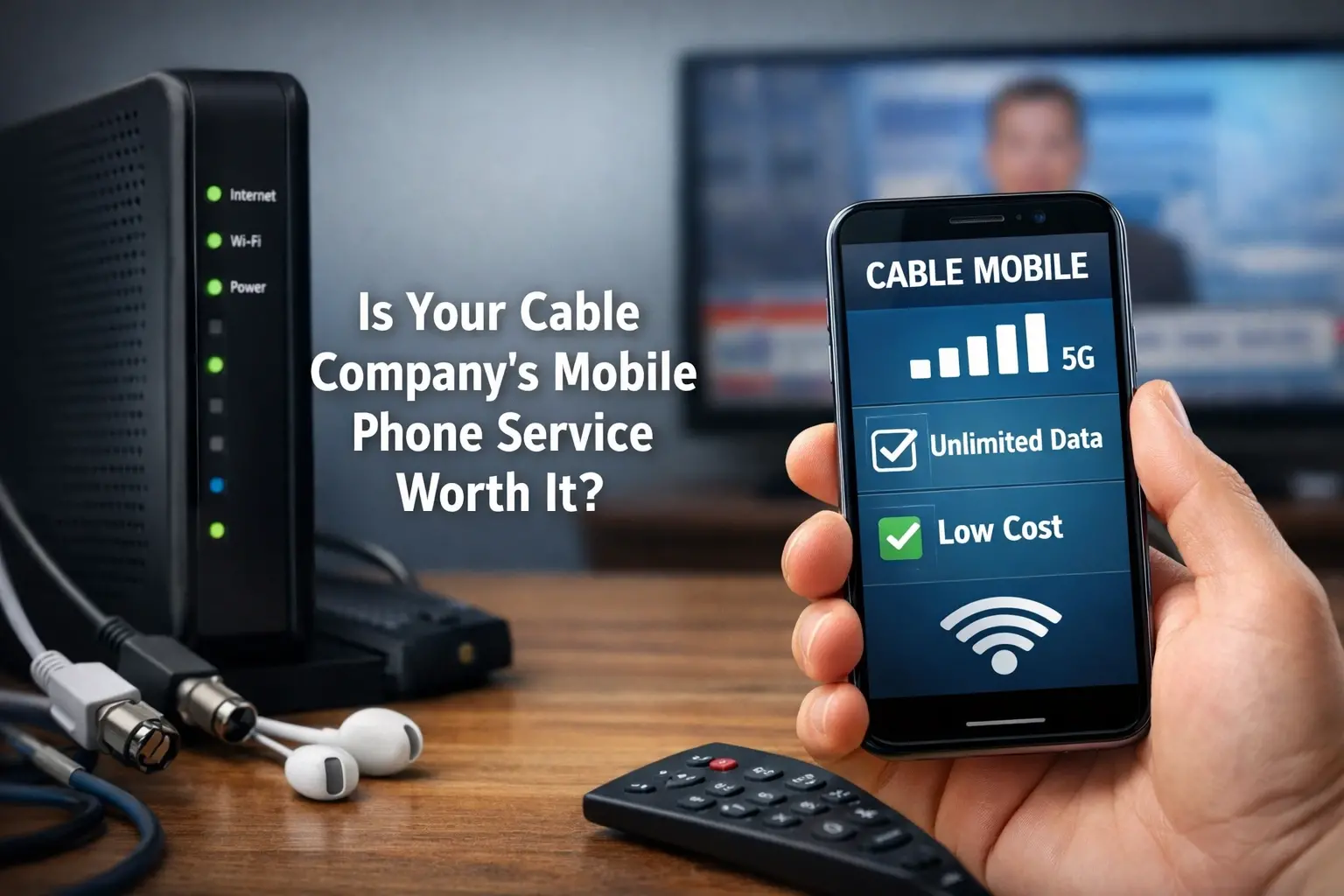
Cable providers spent decades competing on television and broadband. Now they're competing for the phone in your pocket. Comcast's Xfinity Mobile, Charter's Spectrum Mobile, Cox Mobile, and Optimum Mobile have collectively signed up millions of subscribers by offering wireless service that rides on the same towers as Verizon, T-Mobile, and AT&T — often for less money.
That's the pitch, anyway. The real answer to whether a cable company's mobile plan is worth it depends on how you use your phone, whether you're already a broadband customer, and how much you value network priority during busy hours. This analysis looks at how these plans actually work, what independent research says about their performance, and where they tend to fall short of the carriers whose networks they lease.
Quick Answer
For most existing broadband customers with light-to-moderate data use, a cable company's mobile plan is worth it — the pricing is typically lower than a comparable postpaid plan from a major carrier, and coverage quality matches the underlying network. It's less worth it for heavy data users, people who travel to rural or high-traffic areas, or anyone who wants premium perks like device financing flexibility, cutting-edge streaming bundles, or guaranteed network priority.
Key Findings
Cable mobile plans — known as Mobile Virtual Network Operators, or MVNOs — lease network capacity from a major carrier rather than owning towers themselves. Xfinity, Spectrum, Cox, and Optimum lease network capacity from T-Mobile, Verizon, and AT&T to deliver coverage under their own brand names, an arrangement known as a Mobile Virtual Network Operator.
Spectrum Mobile, Xfinity Mobile, and Cox Mobile all operate on Verizon's network, combined with each provider's own network of WiFi hotspot locations.
Pricing is a genuine advantage: the cheapest Spectrum Mobile and Xfinity Mobile plans both start around $15 per month, well under typical unlimited plans from the major postpaid carriers.
Customer sentiment research shows real satisfaction gaps by provider: 87% of surveyed Spectrum Mobile customers reported satisfaction with the service's reliability, a figure that outperformed T-Mobile, AT&T, Cox, and Verizon in the same survey.
Deprioritization during network congestion is the central trade-off: postpaid traffic on the underlying host carrier still gets priority over MVNO traffic, even though Spectrum Mobile and Xfinity Mobile share identical raw coverage because they both run on Verizon's network.
Data caps still vary meaningfully by brand: Cox Mobile's Gig Unlimited plan carries a 20GB high-speed data cap that is modest next to Spectrum Mobile and Xfinity Mobile, both of which have rolled out plans with much larger data allowances.
How Cable Mobile Plans Actually Work
The economics are straightforward. Building a nationwide cellular network costs tens of billions of dollars, so instead of building their own, cable companies buy wholesale access to an existing carrier's towers and resell that access under their own brand, bundled with the internet and TV services they already sell you. Because these companies are heavily incentivized to attach mobile service to a broadband subscription, the sharpest pricing is almost always reserved for customers who bundle mobile with home internet, rather than for mobile-only customers.
That bundling strategy explains why cable mobile plans can undercut standalone carriers on price: the cable company is already collecting a broadband bill from you, so the mobile line is a lower-margin add-on designed to reduce the odds you'll switch internet providers, not a standalone profit center.
The Network Question: Whose Towers Are You Really Using?
This is the single most important technical fact to understand before signing up. Spectrum Mobile, Xfinity Mobile, and Cox Mobile all run on Verizon's cellular network layered with each company's own WiFi hotspot network, which means coverage quality in most areas will closely track Verizon's own coverage map. Optimum Mobile, by contrast, has historically used a mix of T-Mobile and other carrier agreements — always confirm the underlying network before signing up, since it determines your actual coverage in rural or fringe areas.
Because Spectrum Mobile and Xfinity Mobile share the same host network, their raw coverage is identical; what differs between them is plan structure, pricing tiers, and where each falls in the carrier's deprioritization queue during high-traffic periods.
Price Comparison
Provider | Starting Price | Host Network | Notable Trade-off |
|---|---|---|---|
Spectrum Mobile | ~$15/mo (with internet) | Verizon | Smaller data caps on entry plans |
Xfinity Mobile | ~$15/mo (with internet) | Verizon | Requires Xfinity Internet for best rates |
Cox Mobile | Discounted per line, down to $30/mo with 4+ lines | Verizon | 20GB data cap on its Gig Unlimited plan, smaller than rival jumbo-data plans |
Optimum Mobile | Varies by region | Mixed carrier agreements | Regional availability limits |
Pricing reflects publicly listed starting rates as of mid-2026 and varies by region, line count, and bundle status. Always confirm current rates directly with the provider.
What Independent Research Says About Reliability
Reliability perception varies more than the underlying network technology would suggest, which tells you customer experience with a cable MVNO isn't just about towers — it's about how the company manages congestion, billing, and support. Consumer research firm CableTV.com's ongoing satisfaction survey work found that Spectrum Mobile customers rated the service's reliability ahead of T-Mobile, AT&T, Cox, and Verizon, with only GFiber and Starlink edging it out by a small margin. That same research found 81% of Spectrum Mobile customers considered it easy to resolve customer service issues, trailing only Cox, Breezeline, and Starlink.
Cox Mobile's standing was more mixed. Researchers found Cox Mobile ranked just behind the major carriers and Xfinity Mobile for overall reliability, but still outperformed rivals like Optimum Mobile and Astound Broadband, and separately, Cox Mobile's Verizon-powered network kept subscribers connected during high-traffic periods better than all providers except Verizon itself, Xfinity Mobile, and Optimum Mobile.
At the industry level, J.D. Power's ongoing wireless research shows the network gap between major carriers and MVNOs has been narrowing. The industry-wide network quality study found problems occurring at a rate of 9 or fewer per 100 uses across the past year, suggesting cellular network performance overall has become consistently strong regardless of which brand a customer's SIM card carries. That's meaningful context: much of the coverage gap consumers used to worry about with MVNOs has shrunk as underlying 4G/5G networks have matured.
J.D. Power's separate satisfaction research also reinforces why price matters so much in this category. The firm's carrier satisfaction study found that value for price paid is the most important driver of overall wireless satisfaction, followed closely by service quality — which is precisely the trade-off cable MVNOs are built to win on price while occasionally losing on peak-time service quality.
Research Insights
Three patterns stand out from reviewing this research landscape that go beyond simply comparing plan prices side by side.
First, the "same network" claim is true but incomplete. Cable MVNO marketing accurately states that customers get access to the same towers as postpaid customers on the host carrier. What that marketing rarely emphasizes is deprioritization: during network congestion — a packed stadium, a holiday weekend, a natural disaster evacuation — postpaid customers of the host carrier get priority routing before MVNO traffic. For the vast majority of daily use, this distinction is invisible. It becomes noticeable only in the specific moments when network capacity is most strained, which is precisely when reliable service matters most.
Second, bundling economics mean mobile-only shoppers get a worse deal than the headline price suggests. Because cable companies use mobile plans primarily as a retention tool for broadband subscribers, the advertised low starting prices typically assume you're already paying for that company's internet service. A cord-cutter or mobile-only shopper comparing sticker prices across providers should confirm whether quoted rates require an active internet subscription, since the effective monthly cost changes substantially without one.
Third, data cap structure is now the real differentiator between cable MVNOs, not network quality. With host-network performance converging across providers, the meaningful competitive gap has shifted toward hotspot data allowances, international roaming terms, and per-line discount structures — areas where plans like Cox Mobile's 20GB-capped Gig Unlimited tier now look comparatively modest next to competitors offering much larger data buckets.
Consumer Impact
For a household already bundling internet and TV with a cable provider, adding a mobile line is often the lowest-friction way to shave a real amount off a monthly wireless bill without changing SIM cards to an unfamiliar carrier or losing access to the same cell towers they already rely on. The savings compound with each additional line added to a family plan, particularly with providers offering per-line bundle discounts.
The calculation looks different for heavy data users — frequent hotspot users, remote workers who tether laptops, or households that stream extensively over cellular — who should scrutinize data caps and deprioritization thresholds closely, since exceeding a plan's high-speed allotment typically triggers reduced speeds for the rest of the billing cycle.
Future Outlook
Expect cable MVNOs to keep expanding data allowances and adding perks like international roaming and device trade-in credits as competition with T-Mobile, Verizon, and AT&T's own low-cost sub-brands intensifies. As 5G network capacity continues to grow nationally, the practical difference between deprioritized MVNO traffic and postpaid priority traffic should keep narrowing outside of the most congested urban corridors and large public events — meaning the value case for cable mobile plans is likely to strengthen over time rather than weaken, provided pricing stays disciplined against internet-only competitors and standalone budget carriers.
Research Methodology
This analysis draws on publicly available research and reporting, including J.D. Power's U.S. Wireless Carrier Satisfaction Study and U.S. Wireless Network Quality Performance Study, CableTV.com's ongoing customer satisfaction survey series covering Spectrum Mobile, Xfinity Mobile, and Cox Mobile, industry coverage comparing MVNO plan structures and pricing, and published plan and pricing data from the providers themselves. Figures reflect the most recently published data available as of mid-2026 and are subject to change as providers update pricing and plan terms.
FAQ
Is a cable company mobile plan the same quality as Verizon, T-Mobile, or AT&T?
Coverage-wise, yes in most areas — cable MVNOs lease access to the same towers as the host carrier. The difference is most apparent during network congestion, when postpaid customers on the host carrier's own plans typically receive routing priority over MVNO traffic.
Do I have to bundle internet service to get the best mobile pricing?
Usually yes. Most cable MVNO pricing, including entry-level plans around $15 a month, assumes an active internet subscription with that provider. Mobile-only pricing without a bundle is typically higher.
Which cable mobile provider has the best reliability?
Independent customer surveys have found Spectrum Mobile customers reporting particularly high satisfaction with reliability, while Cox Mobile has ranked strongly for keeping subscribers connected during high-traffic periods. Actual performance varies by region and which host network a provider uses.
Can I keep my phone number if I switch to a cable mobile plan?
Yes. Number portability is protected under FCC rules, and switching providers while keeping your existing number typically takes anywhere from 15 minutes to a few hours once you have your port-out PIN from your current carrier.
What's the biggest downside of a cable mobile plan?
Deprioritization during network congestion and, for some providers, smaller data caps compared to unlimited plans from major carriers. Heavy data users and frequent hotspot users should compare cap sizes carefully before switching.
Are cable mobile plans available everywhere?
No — availability is generally limited to the cable provider's existing service footprint, since these plans are designed as an add-on for existing broadband and TV customers in that region.
Conclusion
A cable company's mobile plan is a legitimate money-saver for the majority of households, particularly those already paying for that provider's internet service. The underlying network quality is typically identical to what you'd get from the host carrier directly, and independent customer research shows several cable MVNOs — Spectrum Mobile and Cox Mobile among them — performing competitively on reliability and support. The trade-offs worth weighing before switching are deprioritization during peak congestion and, depending on the provider, more limited data caps than a comparable unlimited plan from a major carrier. Readers comparing cable and traditional carrier options can find additional provider research and availability information on CtvforMe.com, or speak with a representative directly at (855) 210-8883 to review current plans in their area.