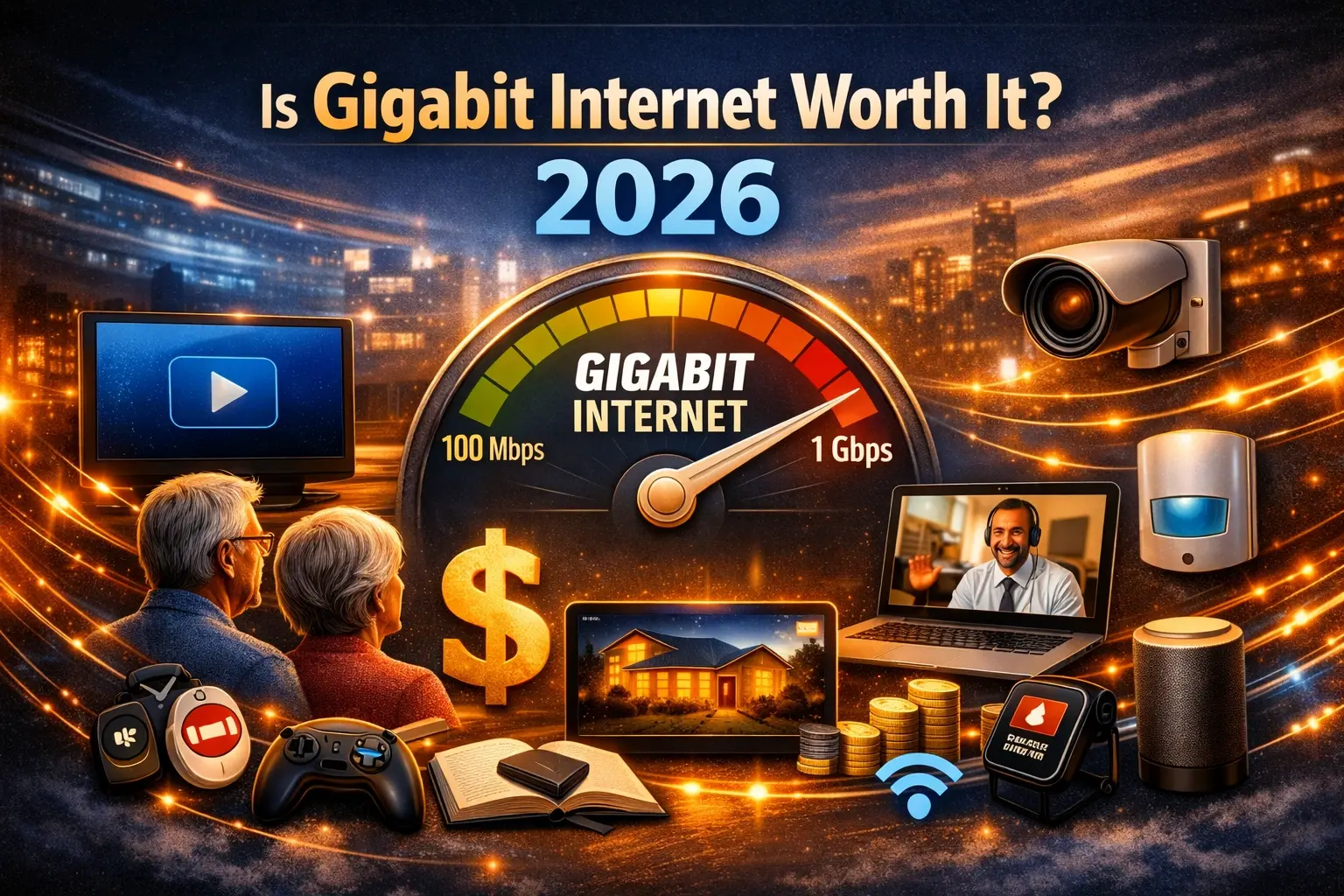
Gigabit internet — plans advertised at 1,000 Mbps or faster — has gone from a niche upgrade to a mainstream marketing pitch in just a few years. Fiber providers now push symmetrical gigabit speeds as the default "best" plan, cable operators have followed with their own multi-gig tiers, and monthly pricing for gigabit service has fallen substantially as competition has intensified. But availability and affordability are only part of the equation. The more important question for most households is whether they can actually use a connection that fast — and whether the price difference between a mid-tier plan and a gigabit plan buys anything meaningful in day-to-day life.
This article breaks down what gigabit internet actually delivers, who benefits most from it, and how to evaluate whether it's worth the upgrade based on current broadband research rather than provider marketing copy.
Quick Answer
For most households of one to four people doing typical activities — streaming, browsing, video calls, and gaming — gigabit internet is not strictly necessary. A well-provisioned 200–500 Mbps plan comfortably handles simultaneous 4K streaming, remote work, and a houseful of connected devices. Gigabit service becomes genuinely worthwhile for larger households (five or more heavy users), homes with 20+ connected smart devices, people who regularly upload or download very large files, and anyone who wants long-term headroom as household bandwidth demand continues to climb. Because fiber-based gigabit plans typically deliver symmetrical upload and download speeds, they also solve the upload bottleneck that limits many cable connections — which matters more than raw download speed for remote work, cloud backups, and video conferencing.
Key Findings
U.S. household internet usage has climbed sharply: recent industry usage data shows the average American household now consumes several hundred megabits per second in downstream traffic during peak hours, driven largely by streaming and connected devices.
Only a portion of U.S. households currently subscribe to gigabit-tier service, even though gigabit availability now reaches a majority of the country, according to FCC broadband deployment data — indicating a meaningful gap between access and adoption.
Fiber providers deliver dramatically better upload performance than cable competitors. Fiber connections commonly deliver upload speeds in the hundreds of megabits per second. At the same time, standard cable plans typically top out well below 50 Mbps upload — a gap that matters more each year as remote work and cloud backups become routine.
The average U.S. fixed broadband download speed has climbed to roughly 240–300 Mbps depending on the measurement period and methodology, according to Ookla Speedtest Intelligence data — meaning the "typical" American connection today is already faster than what most households strictly require.
Gigabit subscriptions have grown substantially since 2020, tracking both expanding fiber buildouts and declining per-gigabit pricing, according to industry infrastructure data.
U.S. households now average well over a dozen connected devices, according to consumer research from Parks Associates, a trend that increases aggregate bandwidth demand even when no single device requires much on its own.
Main Analysis: What Gigabit Speed Actually Buys You
The Technical Reality of 1,000 Mbps
A gigabit connection can theoretically download a two-hour 4K movie in well under a minute, support dozens of simultaneous 4K streams, and handle massive file transfers for creative professionals in a fraction of the time a 100 Mbps connection would need. In practice, very few everyday activities come close to using that much bandwidth at once.
Streaming a single 4K video typically requires 15–25 Mbps. A video call needs roughly 4–6 Mbps in each direction. Online gaming is dominated by latency, not raw throughput, and rarely needs more than a few Mbps. Even a household running three or four of these activities simultaneously — several 4K streams, a video call, and background smart-home traffic — typically lands in the 100–300 Mbps range, well short of a full gigabit.
Where gigabit speed genuinely shows its value is in aggregate and burst scenarios: multiple people in a household doing bandwidth-heavy tasks at the same time, large file uploads or downloads (video editing footage, cloud photo backups, big game downloads), and homes with a growing number of always-connected smart devices that each contribute small but constant background traffic.
Upload Speed Is the More Important Number for Many Households
One of the most consistent findings in current broadband research is that upload speed — not download speed — is the actual bottleneck for a large share of households. Cable providers commonly advertise fast download tiers while capping upload speeds far lower, sometimes below 35 Mbps even on plans that offer several hundred Mbps down. That asymmetry becomes a real problem for households with multiple remote workers on simultaneous video calls, content creators uploading large files, or anyone relying on continuous cloud backup.
Gigabit fiber plans typically resolve this because fiber technology delivers symmetrical speeds — upload performance close to or matching the advertised download speed. For households where the upload bottleneck is the actual daily frustration, gigabit fiber can be worth the upgrade even if the household never touches anything close to 1,000 Mbps down.
Pricing Has Changed the Math
Gigabit plans used to carry a steep premium over mid-tier service. That gap has narrowed considerably as fiber competition has expanded and per-gigabit infrastructure costs have fallen. In many competitive markets, the price difference between a 300–500 Mbps plan and a gigabit plan from the same provider is now modest — sometimes just a few dollars a month — which changes the value calculation. When the cost delta is small, gigabit service can make sense purely as future-proofing, even for households that don't currently need the extra capacity.
Readers evaluating their own options can compare current plans and availability at ctvforme.com, where updated pricing and provider information is maintained by market.
Research Insights
Several patterns emerge when current broadband data is viewed together rather than in isolation.
First, there's a growing gap between what providers are building and what consumers are buying. Gigabit infrastructure now reaches a majority of U.S. households, according to FCC deployment data, but actual gigabit subscription rates remain meaningfully lower than availability rates. This isn't purely a marketing failure — it reflects the fact that most households genuinely don't need gigabit speed for their current usage patterns, and many are reasonably skeptical of paying for capacity they can't use.
Second, the "average" household bandwidth footprint is rising faster than most people realize, even if peak individual application needs haven't changed dramatically. The growth isn't coming from any single new "killer app" — it's coming from the steady accumulation of connected devices, each contributing background traffic, combined with more households running multiple simultaneous high-bandwidth activities than in years past. This suggests that even households comfortably served by a 200–300 Mbps plan today may find themselves pushing those limits within a few years, which is the strongest argument for gigabit as future-proofing rather than a strict current-day requirement.
Third, network type matters more than the headline speed number. A gigabit connection over congested or oversubscribed cable infrastructure during peak evening hours can deliver a worse real-world experience than a well-provisioned fiber connection at a lower advertised speed, because fiber networks are generally less susceptible to the shared-bandwidth congestion that affects cable during high-traffic periods. Consumers comparing plans should weigh technology type (fiber vs. cable vs. fixed wireless) alongside the advertised speed tier.
Consumer Impact
For the typical household, the practical impact of this data is straightforward: most people are not currently bandwidth-constrained by their existing mid-tier plans, and the jump to gigabit will not be noticeable for routine daily use. Where the impact is real is in specific, identifiable scenarios:
Large households (5+ people, heavy multi-device use): Gigabit reduces the risk of peak-time slowdowns when several people are streaming, gaming, and video-calling at once.
Remote workers and hybrid households: Symmetrical fiber upload speeds solve the video call and cloud sync bottlenecks that asymmetric cable plans create.
Smart home enthusiasts: Households with dozens of connected devices benefit from the additional headroom, since aggregate background traffic from many low-usage devices adds up.
Content creators and heavy uploaders: Anyone regularly moving large files benefits directly from higher upload ceilings.
Budget-conscious single users or couples: For this group, a mid-tier plan in the 100–300 Mbps range is usually sufficient, and the money saved by skipping gigabit is better spent elsewhere.
Households uncertain about which category they fall into can request a usage-based recommendation by calling (855) 210-8883, where current plan options and speed guidance are available based on address and household needs.
Future Outlook
Bandwidth demand has moved in one direction for over two decades, and current research does not indicate that trend is reversing. Emerging drivers likely to push household bandwidth needs higher over the next several years include:
Continued growth in 4K and emerging 8K streaming adoption
Expansion of AI-powered smart home devices and always-on cloud assistants
Cloud gaming services, which are more bandwidth- and latency-sensitive than traditional downloaded gaming
Growing reliance on cloud backup for photos, video, and work files
Multi-gig Wi-Fi standards (Wi-Fi 6E and Wi-Fi 7) becoming standard in new routers, which are only fully useful when paired with a connection fast enough to feed them
Industry infrastructure investment reflects this trajectory. Providers are increasingly deploying multi-gigabit and even multi-gig-plus tiers in competitive fiber markets, suggesting that today's "gigabit" ceiling may itself look modest within the next several years. For households evaluating an upgrade now, choosing a provider with a clear upgrade path — rather than just the cheapest current gigabit price — is a reasonable hedge against future needs.
Frequently Asked Questions
Is gigabit internet overkill for a typical household?
For most households of one to four people doing standard activities like streaming, browsing, and video calls, yes — a 200–500 Mbps plan is generally sufficient. Gigabit becomes more valuable for larger households, heavy simultaneous device use, or anyone who regularly uploads large files.
What's the real difference between gigabit and a 500 Mbps plan?
In daily use, most people won't notice a difference, since few home activities require more than a few hundred Mbps even when run simultaneously. The practical difference shows up mainly in burst scenarios — large downloads, multiple heavy users at once, and future headroom as bandwidth needs grow.
Does gigabit internet improve gaming performance?
Not significantly. Online gaming depends primarily on latency (ping) and connection stability rather than raw download speed. A fast connection with high latency will perform worse for gaming than a modest connection with low, consistent latency.
Is fiber gigabit better than cable gigabit?
Generally, yes. Fiber gigabit plans typically deliver symmetrical upload and download speeds and tend to hold up better during peak congestion hours, while cable gigabit plans often have much lower upload speeds and can be more susceptible to shared-network slowdowns.
How many devices can gigabit internet support?
A gigabit connection can comfortably support dozens of connected devices, including smart home equipment, streaming devices, and multiple simultaneous users, provided the in-home Wi-Fi router and equipment are also capable of handling that throughput.
Will I need gigabit internet in the future even if I don't need it now?
Possibly. Household bandwidth consumption has risen steadily for years, driven by more connected devices and higher-resolution streaming. Choosing gigabit now can serve as future-proofing, particularly if the price difference versus a mid-tier plan is small.
Does upload speed matter as much as download speed?
For many households, upload speed matters more in practice. Remote work, video calls, and cloud backups all depend on upload bandwidth, and this is where many affordable cable plans fall short compared to symmetrical fiber gigabit service.
How do I know if gigabit is available at my address?
Availability varies significantly by location and depends on local fiber and cable infrastructure. Checking current availability and pricing by address is the most reliable way to know what's actually offered, which can be done through resources like ctvforme.com or by speaking with a specialist at (855) 210-8883.
Conclusion
Gigabit internet isn't a universal necessity, but it isn't a gimmick either. The honest answer depends on household size, the number of simultaneous heavy users, how much upload-dependent work happens in the home, and how much weight a household wants to place on future-proofing against rising bandwidth demand. For many households, a well-chosen mid-tier plan delivers everything they need today at a lower monthly cost. For larger, more connected, or upload-dependent households, gigabit — particularly over fibre — solves real bottlenecks that no amount of Wi-Fi optimisation can fix. The best approach is to evaluate actual household usage patterns against current plan pricing rather than defaulting to the fastest available tier by habit.