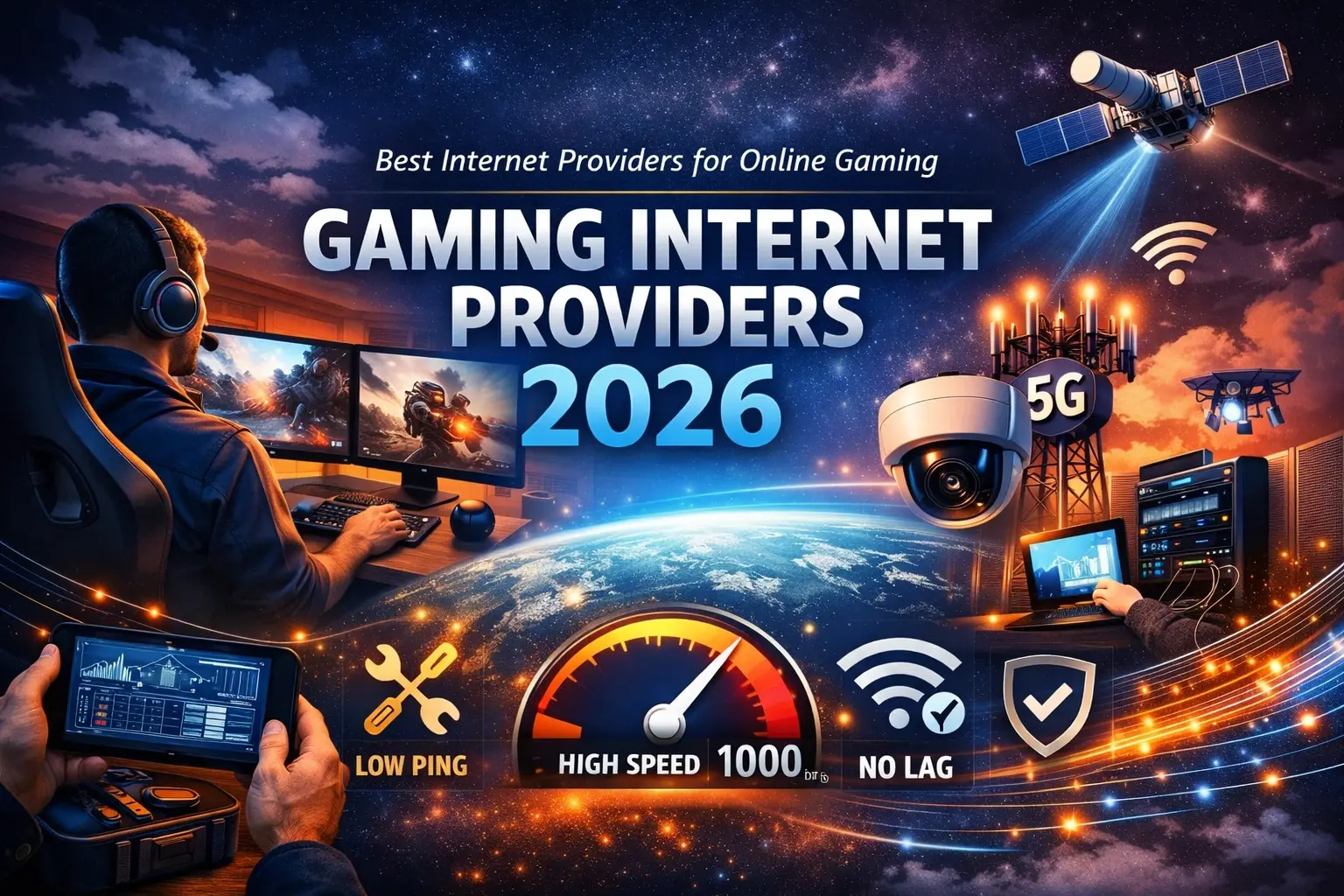
Online gaming has quietly become one of the most demanding everyday uses of a home internet connection — more demanding, in many respects, than 4K streaming. A dropped frame in a video is barely noticeable. A 100-millisecond latency spike during a competitive match can be the difference between winning and losing a round. As gaming has shifted toward always-online titles, cloud gaming platforms, and cross-play ecosystems, the definition of a "good" internet connection has changed with it.
This article breaks down what the research and industry data actually say about which internet technologies and providers perform best for gaming in 2026, based on published speed and latency data from Ookla's Speedtest Intelligence platform, FCC broadband reports, and independent testing organizations. It is intended as an educational resource for consumers trying to separate marketing claims from measurable network performance — not a ranked list of "winners," since the right provider depends heavily on what is actually available at a given address. Readers can browse additional resources on providers and availability at ctvforme.com.
Quick Answer
For most gamers, fiber-optic internet is the best available technology for online gaming, because it delivers the lowest and most consistent latency (commonly 5–20 milliseconds) along with symmetrical upload and download speeds. Where fiber isn't available, a high-tier cable plan is the next-best option, followed by fixed wireless and, as a last resort in rural areas, satellite service. Speed matters less than consistency: a stable 100–300 Mbps fiber or cable connection with low jitter will outperform a faster but less stable connection for real-time multiplayer games.
Key Findings
Latency, not raw speed, is the primary driver of gaming performance. Industry guidance generally places competitive-grade latency under 20ms, with 30–50ms considered playable for casual multiplayer gaming.
Fiber-optic connections post the lowest average latency among residential technologies. Aggregated 2026 testing data puts fiber latency around 12ms on average, compared with roughly 18ms for cable, 32ms for 5G fixed wireless, and 48ms for satellite services.
The FCC's benchmark for broadband no longer reflects gaming-household needs. The Commission's current fixed broadband standard is 100 Mbps download and 20 Mbps upload — adequate for basic connectivity, but analysts note it wasn't designed around latency-sensitive, multi-device gaming households.
Satellite internet has improved dramatically but still trails wired options. Modern low-earth-orbit satellite service can support most online games with average latency in the 25–50ms range, a significant improvement from earlier geostationary satellite services that averaged several hundred milliseconds.
Upload speed is an underrated factor for streamers and voice-chat-heavy players. Fiber's symmetrical speeds give it a structural advantage over cable, which typically offers far lower upload than download speeds on standard tiers.
Availability, not performance, is usually the deciding factor. Fiber networks continue to expand but still do not reach every household, meaning the "best" technically available option often comes down to a household's specific address.
Main Analysis: How Connection Types Compare for Gaming
Fiber-Optic Internet
Fiber-optic connections use pulses of light through glass fiber rather than electrical signals over copper or coaxial cable, which is why they consistently post the lowest latency and least interference of any residential internet technology. Because fiber networks are typically built with symmetrical upload and download capacity, they're particularly well-suited to gamers who also stream their gameplay, since real-time video upload competes for the same bandwidth as game traffic on asymmetrical connections. Fiber providers have also generally moved away from data caps, which matters given that modern game installations and updates routinely run into the tens or low hundreds of gigabytes. The main limitation of fiber is physical: it requires new infrastructure to be built to each home, so availability remains concentrated in cities and expanding suburban markets rather than being universal.
Cable Internet
Cable internet, delivered over the same coaxial infrastructure used for television service, remains the most widely available high-speed option in the United States and a reasonable fallback where fiber hasn't been built out. Cable can deliver latency low enough for most online gaming, though because bandwidth is shared among neighborhood subscribers on a local network segment, performance can degrade somewhat during peak evening hours when many households are online simultaneously. Upload speeds on standard cable tiers also lag well behind download speeds, which is worth factoring in for anyone who streams gameplay or relies heavily on voice chat during play.
5G Fixed Wireless
Fixed wireless home internet, delivered over cellular network infrastructure, has expanded rapidly as an alternative in suburban and some rural areas without fiber or cable access. Latency on fixed wireless tends to run noticeably higher than wired options, and performance can vary based on distance from the nearest tower, network congestion, and weather. It's a workable option for casual and moderately competitive gaming but generally isn't the first choice for players prioritizing the lowest possible ping.
Satellite Internet
Low-earth-orbit satellite constellations have transformed satellite internet from a technology largely unsuited to gaming into a genuinely viable option for rural households with no other choice. Average latency in the 25–50ms range is workable for most casual and many competitive titles, though periodic latency spikes during satellite handoffs can still affect the most latency-sensitive gameplay. This represents a substantial improvement over legacy geostationary satellite services, which historically produced latency too high for real-time multiplayer gaming.
DSL
DSL, delivered over aging copper telephone lines, generally posts the highest latency and lowest speeds of the mainstream residential technologies and is considered a weak option for serious online gaming. It may remain the only wired option in some rural areas, but consumers with any other choice available typically find a meaningful performance improvement by switching.
Frequently Asked Questions
What internet speed do I actually need for online gaming?
Most online multiplayer games function on relatively modest bandwidth — often well under 25 Mbps per active gaming device — but modern households benefit from higher overall plan speeds to account for simultaneous streaming, downloads, and multiple connected devices. A total plan speed of 100–300 Mbps comfortably covers most gaming households, with the specific number mattering far less than latency and connection stability.
Is fiber internet always better than cable for gaming?
Fiber generally outperforms cable on latency and upload speed due to its underlying technology and typically symmetrical design, but a well-provisioned cable connection can still deliver a smooth gaming experience for most players. The gap between the two matters most for competitive players and for anyone who streams gameplay, where upload bandwidth and latency consistency carry more weight.
Can I game well on satellite internet?
Modern low-earth-orbit satellite internet has improved substantially and can support most casual and many competitive games, though it still generally trails fiber and cable on latency consistency. It represents a meaningful upgrade for rural households that previously had no viable option for real-time online gaming.
Does the FCC's broadband definition guarantee good gaming performance?
No. The FCC's current fixed broadband benchmark of 100 Mbps download and 20 Mbps upload is a speed-based standard used primarily for measuring deployment and funding eligibility; it does not include a latency or reliability requirement, so meeting the federal definition doesn't guarantee a connection is well-suited to real-time gaming.
Why does upload speed matter for gaming?
Upload speed affects how quickly your device sends data to game servers and other players, which matters for real-time responsiveness, and it becomes especially important for anyone who livestreams gameplay or relies on video/voice chat during play. Connections with low upload speed relative to download speed can create a bottleneck even when download speeds look strong.
How much does data usage matter for gamers?
It matters more than it used to. Contemporary game installations and updates frequently range from tens of gigabytes to over 100GB, and households that also stream video can accumulate substantial monthly data usage. Plans with low data caps or overage charges are worth scrutinizing for active gaming households.
Is 5G home internet a good option for gaming?
5G fixed wireless can support casual and moderate online gaming reasonably well, though its latency and consistency generally lag behind fiber and cable. It's a reasonable option where wired infrastructure isn't available, particularly for less latency-sensitive game types.
Conclusion
Choosing an internet plan for gaming ultimately comes down to matching connection technology and provider availability with actual usage patterns — competitive multiplayer, casual online play, game streaming, or some combination of all three. The research consistently points toward fiber as the strongest available technology where it exists, cable as a solid and widely available alternative, and meaningful recent improvement in both fixed wireless and satellite options for households without wired access. Rather than chasing the highest advertised download number, gaming households are generally better served by prioritizing low, consistent latency and adequate upload bandwidth. Readers comparing specific providers and plans in their area can find further research and provider information at ctvforme.com.