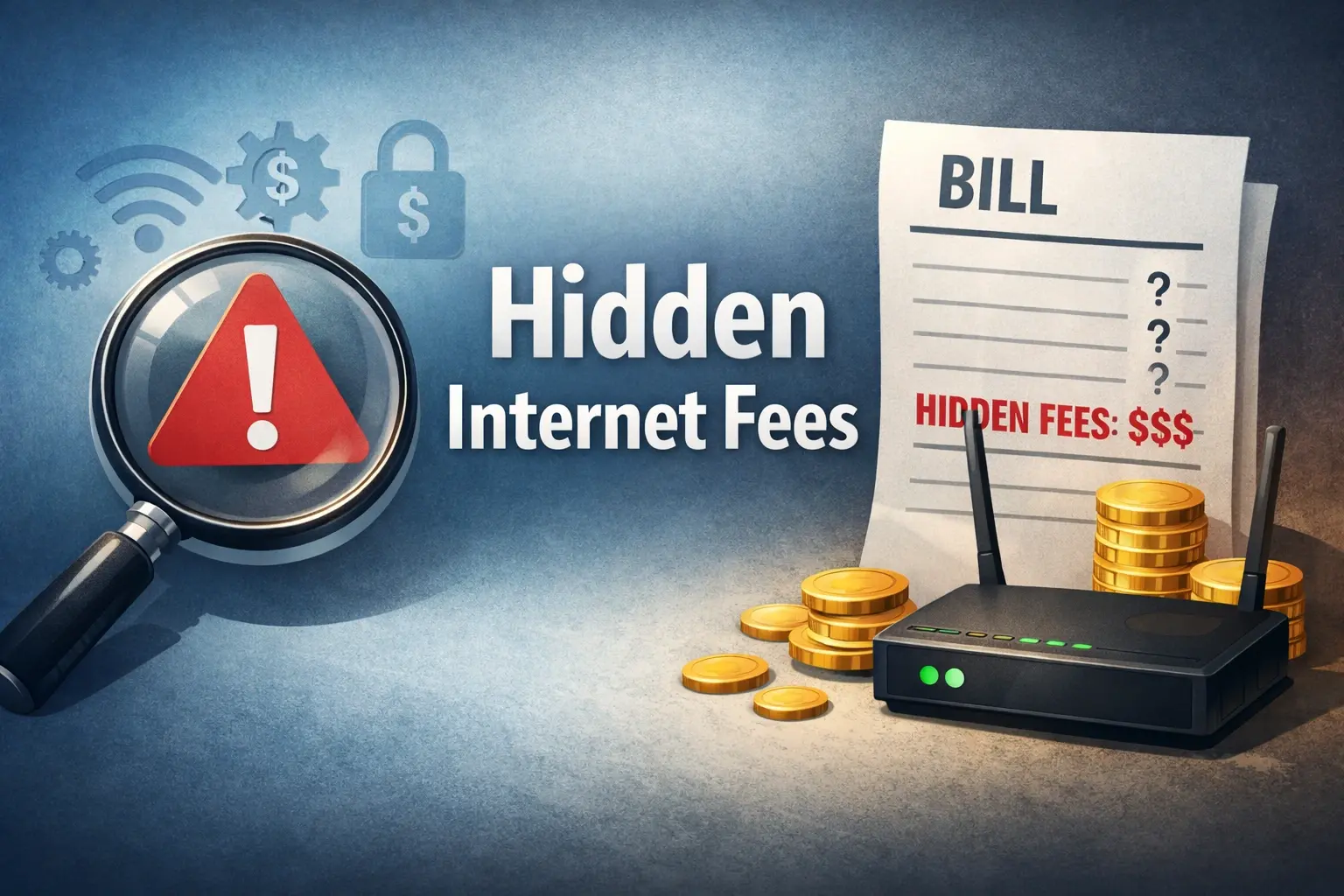
Internet providers routinely advertise promotional rates that exclude several mandatory monthly charges. The most common hidden fees include equipment rental fees ($10–$15/month), broadcast TV surcharges ($10–$20/month), early termination fees ($100–$400), installation and activation fees ($10–$100), data overage charges ($10 per 50–100 GB), and annual price increases that take effect after a promotional period ends. According to Consumer Reports, company-imposed fees add an average of $37 per month — or roughly $450 per year — to what customers expect to pay based on advertised pricing.
Key Findings
Fee Type | Typical Range | Frequently Disclosed? |
|---|---|---|
Equipment rental (modem/router) | $10–$15/month | Rarely at signup |
Broadcast TV surcharge | $10–$20/month | Often buried in footnotes |
Early termination fee (ETF) | $100–$400 | Disclosed in the contract only |
Installation fee | $45–$100 | Sometimes waived in promotions |
Activation fee | $10–$80 | Often negotiable |
Data overage charge | $10 per 50–100 GB | Disclosed, but minimized |
Price increases after the promo period | $20–$50/month jump | Rarely emphasized at signup |
Annual price adjustment | $1–$30/year | Typically, in terms of service only |
Late payment fee | $5–$25 | Listed in terms, not advertised |
Introduction
Internet service is widely described as a utility — something households pay for once a month at a predictable price. Yet for millions of American consumers, the monthly bill that arrives bears little resemblance to the number that convinced them to sign up.
Promotional pricing, opaque fee structures, and contract language designed to protect providers rather than customers have made ISP billing one of the least transparent categories of household spending. A Consumer Reports analysis of real customer bills found that company-imposed fees add approximately $37 per month beyond the advertised rate. This gap compounds to more than $450 annually for the average subscriber.
This guide examines every category of hidden fee that internet providers routinely exclude from their advertised pricing, explains the regulatory environment that governs (and currently threatens) fee transparency, and provides actionable strategies consumers can use to reduce their actual monthly costs.
The Regulatory Backdrop: FCC Broadband Labels and Their Uncertain Future
In April 2024, the Federal Communications Commission (FCC) implemented a mandatory broadband labeling requirement modeled after FDA food nutrition labels. The rules required ISPs to display a standardized "broadband label" at every point of sale — online, in stores, and over the phone — disclosing introductory rates, regular rates, all recurring fees, data allowances, and contract terms.
The intent was to make comparison shopping straightforward and eliminate the billing opacity that had frustrated consumers for decades.
However, in October 2025, the FCC voted 2–1 to propose eliminating six key consumer disclosure requirements from the broadband label framework. Among the proposed rollbacks: removing the requirement that labels be available in machine-readable format for comparison shopping tools, eliminating the mandate that labels appear in customer account portals, and reducing the archive period for label records. Senators, including Ron Wyden, argued that the rollbacks "recreate exactly the kind of billing opaqueness that Congress sought to end."
For consumers, the practical implication is significant. The broadband label — the most powerful tool available for understanding the true cost of internet service before signing a contract — may become less comprehensive, harder to access, and easier for providers to obscure.
Understanding the hidden fee categories described below is therefore more important, not less, than it was when the label regime was at its most robust.
The 8 Hidden Fees Internet Providers Don't Advertise
1. Equipment Rental Fees
Perhaps the most universally overlooked addition to internet bills, equipment rental fees cover the cost of leasing a modem, router, or gateway device from the provider. While the advertised plan price covers internet service, the hardware required to access it is typically billed separately.
Equipment rental fees for modems and routers typically run between $10 and $15 per month. Over a 24-month promotional contract period, that is $240 to $360 in rental costs alone — enough to purchase a quality third-party modem outright, often with money to spare.
Many providers make rental feel mandatory through product bundling or by failing to mention that FCC rules generally allow customers to use their own certified modems instead. Customers who purchase a compatible modem and router eliminate this fee. The initial outlay, typically $80–$150 for a quality device, pays for itself within one year for most subscribers.
What to do: Before signing up, ask whether you can bring your own device. Verify that your modem is on the provider's approved hardware list. Factor the cost differential into your decision.
2. Broadcast TV Surcharges
For households subscribing to internet-TV bundles, broadcast TV surcharges are among the most aggressively obscured fees in the industry. These surcharges are added to cover the cost of carrying local broadcast networks — ABC, CBS, NBC, and FOX affiliates — and regional sports networks.
The fee is typically $10 to $20 or more per month and is rarely included in advertised bundle pricing. A package promoted at $75.99 per month for internet and TV may carry a mandatory $20 broadcast surcharge that pushes the effective rate to nearly $96 before taxes.
Providers classify these as pass-through costs rather than service fees, which allows them to legally exclude the amounts from headline advertising. The FCC broadband label framework was intended to force disclosure at the point of sale, but the label applies specifically to broadband plans — not to TV add-ons — leaving broadcast surcharges in a regulatory gray zone.
What to do: Ask specifically about broadcast TV and regional sports surcharges before signing any bundle agreement. Compare the total cost, including all surcharges, against standalone fiber internet paired with a streaming service.
3. Early Termination Fees (ETFs)
Early termination fees represent one of the most financially significant hidden costs for internet customers who need to move, change providers, or cancel service before a contract period ends.
ETFs typically range from $100 to $400, and while providers are generally required to disclose them in contracts, they are rarely mentioned at the point of sale. Some providers structure ETFs as prorated — decreasing by a fixed amount each month a customer remains in contract. Others apply a flat fee regardless of how much of the contract remains.
A household locked into a 24-month agreement that moves after 8 months may owe the full prorated balance, which can easily exceed $200. Customers who fail to read the terms before signing frequently discover this only when they call to cancel.
What to do: Avoid term contracts where possible. Several providers — including fiber ISPs and fixed wireless carriers — offer month-to-month plans at competitive rates. If a contract is unavoidable, calculate the maximum ETF exposure and negotiate for fee waivers as part of the signup agreement. Always ask: "What do I pay if I cancel in month 6?"
4. Installation and Activation Fees
New customer fees at signup represent a category where significant money changes hands before service even begins. Installation fees for professional technician visits typically range from $45 to $100. Activation fees — a separate charge for provisioning an account — add another $10 to $80.
Some providers waive one or both fees for online signups, customers who select self-installation, or during promotional campaigns. However, the default pricing often assumes both charges, and customers who don't ask will typically pay them.
What to do: Always request online signup pricing and ask whether self-installation is available. Activation fees are frequently negotiable — customer service representatives often have discretion to waive them, particularly for new accounts.
5. Data Overage Charges
While many top-tier internet plans now advertise "unlimited" data, a large portion of the market — particularly cable internet customers — remains subject to monthly data caps and overage charges.
The structure is typically $10 per additional 50 to 100 GB beyond a monthly cap, though the cap itself may not be prominently disclosed. Some providers offer unlimited data as a paid add-on at $25 to $30 per month, presenting it as an optional upgrade rather than acknowledging that data caps exist at all.
For households with heavy streaming, multiple smart devices, or remote work needs, data caps can result in meaningful recurring overage charges. A family consistently using 100 GB beyond a cap pays an additional $10–$20 monthly — costs that were never reflected in the advertised rate.
What to do: Ask your provider exactly what the monthly data allowance is on the plan you're considering. If a cap exists, request the overage fee schedule in writing. Compare providers with genuinely unlimited plans — many fiber internet providers have eliminated data caps.
6. Annual Price Increases
One of the least-discussed and most financially impactful practices in ISP billing is the annual price increase — a scheduled rate adjustment that providers apply to plans after the promotional period expires, and sometimes within ongoing contract periods.
Promotional rates for internet plans typically last 12 to 24 months. When the promotional period ends, prices can increase by $20 to $50 per month without any notification beyond what is buried in the original terms of service. A plan advertised at $49.99 per month may automatically become $79.99 at month 13.
Additionally, many providers apply annual price adjustment clauses that allow them to raise rates by a fixed amount — often $5 to $10 per year — even within an existing contract period. These adjustments are disclosed in terms of service but are rarely highlighted during the sales process.
A 2025 BroadbandSearch analysis noted that hidden fees, expiring promotions, and annual price hikes can cause a $50-per-month internet plan to cost more than $5,000 over five years — more than double the initial estimate a consumer might make at the time of signup.
What to do: Ask specifically when the promotional rate expires and what the standard rate will be. Request this in writing. Set a calendar reminder for 60 days before the promotional period ends to negotiate, switch providers, or evaluate alternatives.
7. Late Payment Fees
Most providers charge a late payment fee when a monthly bill is not paid by the due date. These fees typically range from $5 to $25, and some providers add a percentage of the outstanding balance on top of the fixed fee.
Late fees are not consistently disclosed during signup and are often categorized in terms of service under sections consumers do not read in full. They are legal, standard across the industry, and easily avoidable — but they disproportionately affect lower-income households managing tight cash flow.
What to do: Enroll in autopay where possible. Many providers offer a $5 to $10 per month discount for autopay enrollment, which more than offsets the risk of an occasional late fee. Confirm the due date, grace period, and late fee amount before signup.
8. Taxes and Government Fees
Internet bills include a range of federal, state, and local taxes and government-mandated fees that providers pass on to consumers. While these are technically not provider-generated fees, they are frequently excluded from advertised pricing, contributing to the disconnect between the rate a customer signs up for and the amount on their first bill.
Common charges in this category include federal USF (Universal Service Fund) fees, state and local telecom taxes, and 911 service fees. The combined total can add $5 to $20 or more per month, depending on the state and municipality.
What to do: Ask the provider for an all-in monthly cost estimate, including taxes, before committing. Use tools on comparison platforms like CtvforMe.com to see all-in pricing transparency across providers available at your address.
Research Insights: Why Fee Opacity Persists
The persistence of hidden fee structures in broadband billing is not accidental. It reflects deliberate pricing architecture designed to optimize headline attractiveness while maximizing total revenue extraction.
Several industry dynamics reinforce this structure:
Limited Competition Reduces the Cost of Opacity. A 2025 analysis found that meaningful competition for high-speed internet (100+ Mbps service) is absent in more than 96% of U.S. counties. When consumers have one or two realistic choices for broadband, providers face little competitive pressure to simplify pricing. Transparency becomes a competitive differentiator only when switching is easy and alternatives are genuinely accessible.
Promotional Pricing Creates Anchor Bias: Consumers evaluate internet plans relative to the advertised rate — a cognitive anchor that persists even when subsequent fees significantly change the actual cost. Providers are aware that the promotional rate shapes perception more powerfully than the full-term cost, which is why fees are disclosed in contract documents rather than in advertising.
Regulatory Uncertainty Favors Status Quo Opacity. The FCC's 2025 proposal to roll back broadband label requirements signals to providers that disclosure requirements may weaken rather than strengthen over time. Without regulatory enforcement, fee transparency depends on competitive pressure — which remains inadequate in most markets.
Consumer Reports' finding that roughly 7 in 10 Americans who have used a cable, internet, or phone provider in the past two years experienced unexpected or hidden fees is not a failure of individual consumers to read fine print. It is evidence of a systemic pricing structure designed to limit pre-purchase transparency.
Which Providers Are Most Transparent?
Not all internet providers operate the same fee architecture. Several ISPs have adopted more transparent pricing models, typically driven by either fiber infrastructure economics or market positioning as a low-opacity alternative.
Providers frequently cited for transparent, simplified pricing include those offering:
Flat-rate plans with no promotional windows
No equipment rental fees (equipment included or sold at cost)
No data caps or overage fees
Month-to-month contracts with no ETFs
Prices listed inclusive of all recurring fees
Fiber internet providers, fixed wireless carriers, and newer entrants to the market tend toward simpler pricing structures — both because their infrastructure economics differ from legacy cable networks and because fee transparency has become a competitive marketing point in markets where fiber and 5G home internet compete directly.
When comparing providers available at your address, CtvforMe.com provides side-by-side plan comparisons that include fee disclosures — or call (855) 210-8883 to speak with an advisor who can walk through the complete cost structure for providers in your area.
How to Fight Hidden Fees Before and After Signup
Before You Sign Up
1. Request a full cost breakdown in writing. Ask the provider to itemize all monthly charges: base plan rate, equipment rental, any applicable surcharges, estimated taxes, and the rate after any promotional period expires. Get this via email or chat transcript, not just a verbal commitment.
2. Check the FCC broadband label. As of 2024, most major ISPs are required to display a broadband label at the point of sale. This label discloses introductory versus standard rates, all recurring fees, and contract terms. If a provider cannot or will not show you the label, treat that as a red flag.
3. Negotiate fees at signup. Activation fees, installation fees, and equipment rental fees are frequently negotiable — particularly for new customers. Simply asking "Can this fee be waived?" is often sufficient. Providers have significant discretion in what they offer to secure a new account.
4. Calculate the total cost of ownership. Multiply the post-promotional rate by 24 months, add estimated equipment rental costs, and compare that number — not the promotional rate — against alternative providers.
After You're a Customer
5. Buy your own modem. Purchase a provider-certified modem and router. The $80–$150 investment eliminates a $10–$15 monthly fee, paying for itself within a year in most cases.
6. Review your bill monthly. Providers sometimes add new fees or increase existing ones without proactive notification. Scan for unfamiliar line items.
7. Call before your promotional period ends. Contact your provider 60 days before the promotional period expires. Retention representatives often have authority to extend promotional pricing, apply loyalty discounts, or upgrade service without additional cost. If they cannot match a competitor's offer, you have time to switch before overpaying.
8. File a complaint if fees weren't disclosed. The FCC's Consumer Complaint Center (consumercomplaints.fcc.gov) accepts complaints about undisclosed fees. The Consumer Financial Protection Bureau (CFPB) handles complaints about billing practices. Filing a complaint creates a regulatory record and often prompts a more rapid resolution from the provider.
Consumer Impact: What Hidden Fees Cost at Scale
The aggregate cost of undisclosed internet fees is substantial. Consumer Reports' analysis identified an average of $37 per month in company-imposed fees added to cable and internet bills beyond the advertised rate — totaling $450 per year per household.
Across approximately 119 million U.S. households with broadband service, even a conservative version of this figure implies tens of billions of dollars in annual consumer spending on charges that were not transparently disclosed at the point of sale.
For individual households, the impact is concentrated among those with the fewest alternatives. In markets with a single dominant cable provider, consumers face a binary choice: accept the full fee structure or forgo broadband service. The American Customer Satisfaction Index (ACSI) consistently gives ISPs some of the lowest consumer satisfaction scores across all tracked industries — a direct reflection of the gap between expected and actual billing.
Frequently Asked Questions
What is the most common hidden fee on internet bills?
Equipment rental fees are the most widespread hidden charge on internet bills. Most providers charge $10 to $15 per month to lease a modem or gateway device, even when this cost is not included in the advertised plan price. Consumers can eliminate this fee by purchasing a compatible modem outright, which typically pays for itself within one year.
Can I avoid internet early termination fees if I need to cancel?
Early termination fees can sometimes be avoided or reduced. Options include using the provider's cancellation window (typically 14 days from service start), finding a provider that offers contract buyout promotions, documenting service quality issues that may justify penalty-free cancellation, or switching to a no-contract month-to-month provider from the start. Always ask about ETF exposure before signing a term agreement.
What is the FCC broadband label, and does it show all fees?
The FCC broadband label, implemented in April 2024, functions similarly to an FDA nutrition label. It discloses introductory and standard rates, all recurring fees, data allowances, contract terms, and speeds for broadband internet plans. However, the label applies specifically to broadband service — not to TV or phone add-ons — which means bundle-specific fees like broadcast surcharges may not appear on the label itself. In October 2025, the FCC proposed rolling back several of the label's disclosure requirements.
How much do hidden internet fees add to my monthly bill?
According to a Consumer Reports analysis of real customer bills, company-imposed fees add an average of $37 per month beyond the advertised rate for cable, internet, and phone service customers. Annually, this totals approximately $450 per household. The actual amount varies by provider, market, and specific plan, but is almost universally higher than advertised pricing suggests.
Why do internet providers charge broadcast TV surcharges?
Broadcast TV surcharges are fees providers charge to cover the retransmission consent costs they pay to local broadcast networks (ABC, CBS, NBC, FOX) and regional sports networks for the right to carry those channels. Providers classify these as pass-through costs, which allows them to exclude the fees from the base advertised pricing. Surcharges typically range from $10 to $20 or more per month and are most common with cable TV bundles.
Is it legal for internet providers to add fees not mentioned in ads?
Yes, providers can legally charge fees not prominently featured in advertising as long as the fees are disclosed somewhere in the contract or terms of service. The FCC's broadband labeling rules were designed to require more transparent disclosure at the point of sale, but enforcement and scope of those rules remain in flux as of 2025–2026. Consumers have recourse through FCC complaint channels and, in some cases, state consumer protection agencies.
How can I find out the real total cost of an internet plan before signing up?
Request an itemized monthly estimate from the provider in writing before signing. Ask specifically about the post-promotional rate, equipment rental fees, any applicable surcharges, and whether data caps apply. Use FCC broadband labels if available. Comparison tools at CtvforMe.com provide side-by-side plan data, including disclosed fees for providers in your area, or call (855) 210-8883 for a personalized cost comparison.
Do fiber internet providers charge fewer hidden fees than cable providers?
Generally, yes. Fiber internet providers — and newer 5G home internet providers — tend to offer more transparent pricing structures with fewer add-on fees. Equipment is often included or sold rather than rented, data caps are less common, and month-to-month plans without early termination fees are more widely available. This fee simplicity has become a competitive marketing point for fiber providers in markets where they compete directly with incumbent cable operators.