What are the pros and cons of fiber compared to copper?
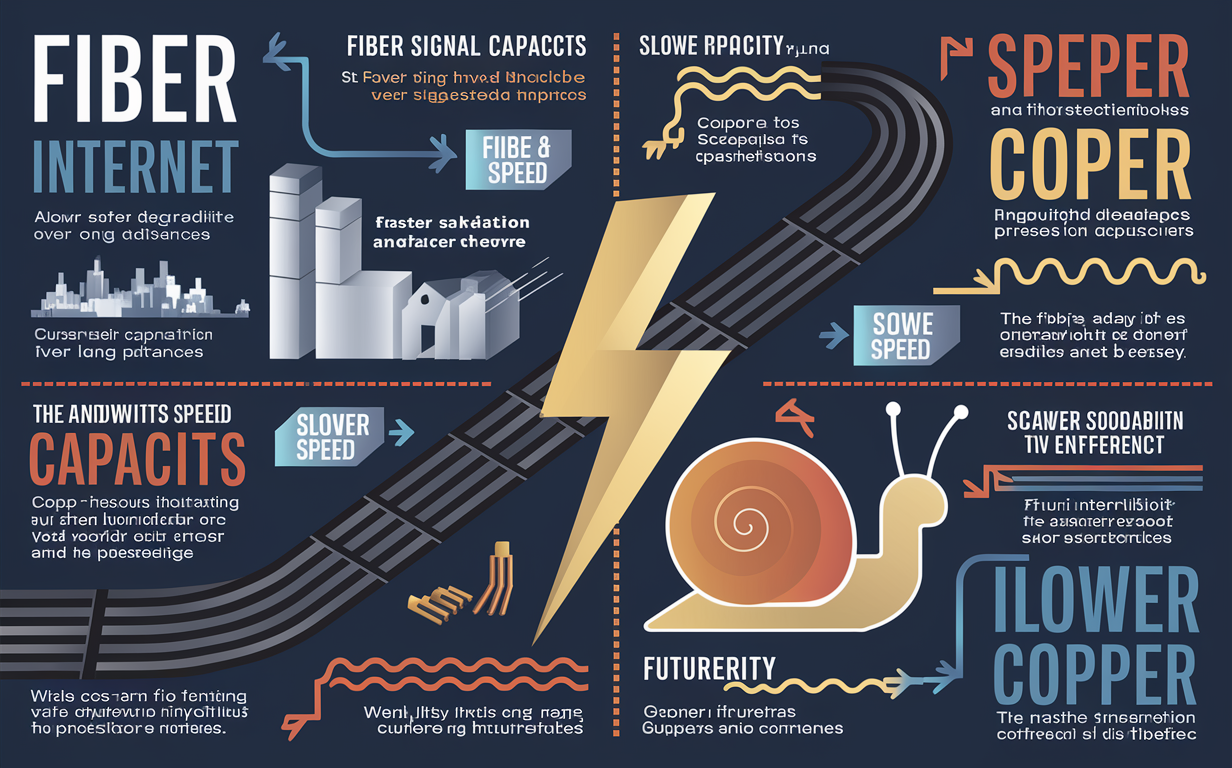
Choosing the right internet connection is crucial for modern life. This guide dives deep into the advantages and disadvantages of fiber optic versus copper (DSL) internet, helping you understand which technology best suits your needs in 2025-26. We'll explore speed, reliability, cost, and future-proofing.
Introduction: The Evolving Landscape of Internet Connectivity
In 2025-26, the demand for faster, more reliable internet is at an all-time high. As our digital lives expand to encompass high-definition streaming, immersive gaming, seamless remote work, and an ever-growing ecosystem of smart devices, the underlying infrastructure becomes paramount. Two primary technologies dominate the residential and small business internet landscape: fiber optic and copper-based Digital Subscriber Line (DSL). Understanding the fundamental differences, advantages, and disadvantages of each is key to making an informed decision that future-proofs your connectivity. This comprehensive guide will dissect fiber versus copper, offering clear insights to help you choose the best internet service for your evolving needs.
Fiber Optics Explained: The Future of Data Transmission
Fiber optic internet, often referred to as "fiber to the home" (FTTH) or "fiber to the premises" (FTTP), represents the cutting edge of internet infrastructure. It utilizes thin strands of glass or plastic to transmit data as pulses of light, offering unparalleled speed and performance. Its adoption has been steadily increasing, driven by the insatiable demand for bandwidth.
How Fiber Optics Work
At its core, fiber optic technology works by sending information encoded as light signals through extremely thin strands of glass or plastic, each about the diameter of a human hair. These strands are bundled together to form fiber optic cables. A light transmitter at one end converts electrical signals into light pulses, which then travel at near light speed through the cable. At the receiving end, a light detector converts these pulses back into electrical signals. The purity of the glass and the precise manufacturing allow light to travel long distances with minimal signal degradation, a phenomenon known as total internal reflection. This method of data transmission is fundamentally different from how copper wires carry signals.
Pros of Fiber Optics
- Unmatched Speed: Fiber optic cables can deliver symmetrical download and upload speeds that are exponentially faster than copper. Speeds of 1 Gbps (Gigabit per second) are common, with providers offering up to 10 Gbps and beyond. This is crucial for bandwidth-intensive activities.
- Superior Reliability: Fiber optic cables are less susceptible to environmental factors like electromagnetic interference (EMI) and radio frequency interference (RFI). They are not affected by power surges or lightning strikes in the same way copper is, leading to fewer outages and more consistent service.
- Lower Latency: Latency, the delay between sending a request and receiving a response, is significantly lower with fiber. This is vital for real-time applications like online gaming, video conferencing, and high-frequency trading.
- Greater Bandwidth: Fiber can carry much more data simultaneously than copper. This means more devices can be connected and used concurrently without a noticeable drop in performance, ideal for large households or businesses with many users.
- Durability: While glass, fiber optic cables are surprisingly robust. They are resistant to corrosion and can withstand a wider range of temperatures than copper.
- Future-Proofing: As internet speeds and data demands continue to grow, fiber optic technology is inherently scalable. The infrastructure is in place to support future speed upgrades without requiring a complete overhaul of the physical cabling.
- Energy Efficiency: Fiber optic transmission uses less energy per bit of data transmitted compared to copper, contributing to a more sustainable infrastructure.
Cons of Fiber Optics
- Availability: Despite rapid expansion, fiber optic networks are not yet available in all areas, particularly in rural or less densely populated regions. Building out new fiber infrastructure is a costly and time-consuming process.
- Installation Cost: While prices are becoming more competitive, the initial installation of fiber optic service can sometimes be more expensive than DSL, especially if new lines need to be run directly to the premises.
- Repair Complexity: If a fiber optic cable is damaged, repairs can be more complex and require specialized equipment and trained technicians, potentially leading to longer downtime in the event of a break.
- Fragility (in some contexts): While durable, the glass strands themselves can be more susceptible to physical breakage if mishandled during installation or if subjected to extreme bending.
Copper (DSL) Explained: The Established Network
Digital Subscriber Line (DSL) technology has been the backbone of internet access for decades. It leverages existing copper telephone lines to transmit data. While it has been surpassed by fiber in terms of raw performance, DSL remains a viable and widely available option for many.
How Copper (DSL) Works
DSL technology uses the unused frequencies on traditional copper telephone lines to carry internet data. Unlike voice calls, which use lower frequencies, DSL utilizes higher frequencies, allowing both services to operate simultaneously over the same line. Data is transmitted as electrical signals. There are several types of DSL, including ADSL (Asymmetric DSL), where download speeds are faster than upload speeds, and SDSL (Symmetric DSL), where speeds are equal. The distance from the telephone company's central office (CO) or a local exchange significantly impacts DSL performance, with signal degradation increasing over longer distances.
Pros of Copper (DSL)
- Wide Availability: Copper telephone lines are present in most homes and businesses, making DSL one of the most widely available internet technologies globally. This makes it a default option in many areas where fiber is not yet deployed.
- Cost-Effectiveness: Generally, DSL plans are more affordable than comparable fiber optic plans, especially for lower speed tiers. The existing infrastructure also means installation costs can be lower.
- Simultaneous Voice and Data: DSL allows for simultaneous use of internet and phone services over the same line without interference, a feature that was critical when it first emerged.
- Simpler Installation: For many users, DSL installation is straightforward, often requiring just plugging in a modem and connecting it to the existing phone jack.
Cons of Copper (DSL)
- Limited Speed: The maximum speeds achievable with DSL are significantly lower than fiber. While some VDSL (Very High-speed DSL) variants can reach hundreds of Mbps, they are often distance-limited. Typical DSL speeds range from 5 Mbps to 100 Mbps download, with much lower upload speeds.
- Distance Degradation: The further you are from the provider's central office or local exchange, the slower and less reliable your DSL connection will be. This is a major limitation for users in rural or remote areas.
- Susceptibility to Interference: Copper lines are prone to electromagnetic interference (EMI) and radio frequency interference (RFI) from appliances, power lines, and even weather conditions, which can cause dropped connections and slower speeds.
- Asymmetrical Speeds: Most DSL connections are asymmetric (ADSL), meaning upload speeds are much slower than download speeds. This can be a bottleneck for activities like uploading large files, video conferencing, or online gaming.
- Aging Infrastructure: The copper network is aging and requires significant maintenance. It is also less capable of supporting the ever-increasing bandwidth demands of modern internet usage.
- Higher Latency: Compared to fiber, DSL generally has higher latency, which can impact real-time applications.
Direct Comparison: Fiber vs. Copper in 2025-26
To truly understand the difference, let's break down the key performance indicators and practical aspects of fiber optic versus copper DSL internet in the current technological landscape of 2025-26.
Speed and Bandwidth
This is arguably the most significant differentiator. Fiber optic technology offers speeds that are orders of magnitude faster than DSL. While DSL speeds can vary greatly depending on distance and technology (e.g., ADSL2+, VDSL2), they typically top out in the low hundreds of Mbps for download, with uploads often being a fraction of that. Fiber, on the other hand, routinely offers symmetrical speeds of 1 Gbps, with 2 Gbps, 5 Gbps, and even 10 Gbps becoming increasingly common. For 2025-26, the average fiber connection offers download speeds exceeding 500 Mbps, while the average DSL connection hovers around 25-50 Mbps. This difference in bandwidth is critical for households with multiple users and devices streaming, gaming, or downloading simultaneously.
Speed and Bandwidth Comparison (2025-26 Averages)
| Feature | Fiber Optic | Copper (DSL) |
|---|---|---|
| Typical Download Speed | 500 Mbps - 10 Gbps+ | 25 Mbps - 100 Mbps |
| Typical Upload Speed | 500 Mbps - 10 Gbps+ (Symmetrical) | 5 Mbps - 20 Mbps (Asymmetrical) |
| Bandwidth Capacity | Extremely High | Limited |
Reliability and Latency
Fiber optic connections are inherently more reliable. They are immune to electrical interference and weather-related disruptions that can plague copper lines. This translates to fewer service interruptions and more stable performance. Latency, the delay in data transmission, is also significantly lower with fiber. In 2025-26, typical fiber latency is often below 10ms, whereas DSL latency can range from 20ms to over 100ms, especially at greater distances. Low latency is paramount for real-time applications like online gaming, where even a few milliseconds can make a difference between winning and losing, and for seamless video conferencing.
Reliability and Latency Comparison (2025-26 Averages)
| Feature | Fiber Optic | Copper (DSL) |
|---|---|---|
| Interference Resistance | Excellent (Immune to EMI/RFI) | Poor (Susceptible to EMI/RFI) |
| Weather Impact | Minimal | Moderate to High |
| Typical Latency | < 10ms | 20ms - 100ms+ |
| Service Stability | Very High | Moderate to Low |
Durability and Interference
Fiber optic cables, while made of glass, are designed to be durable. They are resistant to corrosion and can handle a wider temperature range than copper. The primary advantage here is their immunity to electromagnetic interference (EMI) and radio frequency interference (RFI). Unlike copper wires, which act as antennas for these signals, fiber optic cables transmit light, which is unaffected by electrical noise. This means your fiber connection is less likely to be disrupted by nearby appliances, power lines, or even lightning. Copper, conversely, is a conductor and can pick up these stray signals, leading to degraded performance and dropped connections.
Cost and Installation
Historically, fiber installation has been more expensive, both for the provider to deploy and sometimes for the consumer to set up. However, as fiber deployment matures, the cost gap is narrowing. In 2025-26, while entry-level DSL plans might still be cheaper, the cost per Mbps for fiber has become highly competitive, especially when considering the superior speeds and reliability. Installation for fiber can sometimes involve more complex work, like trenching or running new lines, which might incur higher upfront fees if not already present. DSL, utilizing existing phone lines, often has a simpler and cheaper installation process.
Cost and Installation Comparison (2025-26 General Trends)
| Feature | Fiber Optic | Copper (DSL) |
|---|---|---|
| Monthly Cost (Entry-Level) | Moderate to High | Low to Moderate |
| Monthly Cost (High-Speed Tiers) | Competitive per Mbps | Limited by speed |
| Installation Cost | Potentially Higher (if new lines needed) | Generally Lower |
| Equipment Cost | Modem/ONT often included or rental | Modem often included or rental |
Availability and Future-Proofing
Copper DSL has the advantage of widespread availability due to the existing telephone infrastructure. In many rural or less developed areas, it may be the only high-speed internet option. Fiber optic networks are still expanding, with significant investment in urban and suburban areas. While availability is growing rapidly, it's not yet ubiquitous. From a future-proofing perspective, fiber is the clear winner. Its capacity for speed is virtually unlimited by the physical medium itself, meaning it can easily accommodate future increases in bandwidth demand without requiring new cable installations. DSL, on the other hand, is nearing its physical limits.
Real-World Impact: How Fiber and Copper Affect Your Daily Life
The technical differences between fiber and copper translate directly into how you experience the internet every day. Consider these common scenarios in 2025-26:
Home Entertainment and Streaming
For streaming services like Netflix, Hulu, Disney+, and the growing number of 4K and 8K content providers, fiber optic internet is a game-changer. With gigabit speeds, you can stream multiple 4K streams simultaneously across different devices without buffering. Downloading large movies or games takes minutes, not hours. DSL, especially at lower speeds, can struggle with multiple high-definition streams, leading to buffering, pixelation, and a frustrating viewing experience. Even a single 4K stream can tax a slower DSL connection, especially if other devices are using the internet.
Remote Work and Online Collaboration
The rise of remote and hybrid work models in 2025-26 makes a reliable, fast internet connection essential. For video conferencing platforms like Zoom, Microsoft Teams, and Google Meet, fiber's low latency and high upload speeds ensure clear, stable video and audio, without the lag or dropped calls that can plague DSL connections. Uploading large work files, collaborating on shared documents in real-time, and accessing cloud-based applications are all significantly smoother and more efficient with fiber. DSL can become a bottleneck, making remote work feel less productive and more challenging.
Online Gaming and Virtual Reality
Online gaming demands low latency and high bandwidth for a seamless experience. Fiber optic internet's minimal latency means faster reaction times, crucial for competitive gaming. High download speeds ensure games and updates download quickly. For the burgeoning world of virtual reality (VR) and augmented reality (AR), which often require high-resolution streaming and real-time data transfer, fiber is almost a necessity. DSL's higher latency and slower speeds can lead to lag, desynchronization, and a generally poor gaming or VR experience, making it unsuitable for serious enthusiasts.
Smart Home Technology
As smart homes become more sophisticated in 2025-26, with numerous connected devices (smart thermostats, security cameras, voice assistants, smart appliances), the demand on your home network increases. Fiber optic internet's high bandwidth capacity can easily handle dozens of connected devices simultaneously without impacting performance. DSL, with its limited bandwidth, can become overwhelmed, leading to connectivity issues for some smart devices or a general slowdown of your entire network. Reliable connectivity is key for the functionality and security of smart home systems.
Making the Choice: Which is Right for You?
Deciding between fiber and copper DSL ultimately depends on your specific needs, location, and budget. Here's a breakdown to help you weigh your options.
Key Factors to Consider
- Availability in Your Area: This is the most critical factor. Check with local internet service providers (ISPs) to see what options are actually available at your address.
- Your Internet Usage Habits: Are you a heavy streamer, gamer, remote worker, or do you have a smart home with many devices? Or do you primarily browse the web and check email?
- Speed Requirements: What download and upload speeds do you realistically need? Consider the number of users and devices in your household.
- Budget: How much are you willing to spend on your internet service monthly, and what is your tolerance for upfront installation costs?
- Reliability Needs: How critical is uninterrupted internet service for your work or personal life?
Who Benefits Most from Fiber?
Fiber optic internet is ideal for:
- Power Users: Those who frequently stream 4K/8K content, download large files, or use multiple devices simultaneously.
- Remote Workers and Businesses: Individuals and companies relying on consistent, high-speed connections for video conferencing, cloud access, and large file transfers.
- Online Gamers and VR/AR Enthusiasts: Anyone who requires low latency and high bandwidth for real-time interactive experiences.
- Smart Home Owners: Households with a significant number of connected devices that demand robust network capacity.
- Future-Minded Consumers: Those looking for a long-term solution that can handle increasing data demands for years to come.
When Copper Might Still Suffice
Copper DSL can still be a reasonable choice for:
- Basic Internet Users: Individuals or households that primarily use the internet for email, web browsing, social media, and occasional standard-definition streaming.
- Budget-Conscious Consumers: Those who need the most affordable internet option available and don't require high speeds or low latency.
- Areas with No Fiber Availability: In many rural or underserved areas, DSL might be the only "high-speed" option available.
- Light Home Offices: For very basic remote work tasks that don't involve heavy video conferencing or large file uploads.
The Future of Connectivity: Beyond Fiber and Copper
While fiber optic technology is currently the pinnacle of wired internet for most consumers, the landscape of connectivity is always evolving. Emerging technologies like 5G home internet are beginning to offer competitive speeds and are particularly attractive in areas where fiber deployment is slow or impossible. Satellite internet is also improving, though it still faces challenges with latency and speed for some applications. However, for consistent, high-performance, low-latency internet, fiber optic remains the gold standard for the foreseeable future. Its capacity to scale with future demands is unmatched by current copper infrastructure.
Conclusion: Navigating Your Internet Options
In the 2025-26 digital era, the choice between fiber optic and copper DSL internet significantly impacts your online experience. Fiber optic technology offers superior speeds, unmatched reliability, and lower latency, making it the ideal choice for demanding users, remote workers, gamers, and smart home enthusiasts. Its future-proof nature ensures it can handle the ever-increasing bandwidth requirements of tomorrow. Copper DSL, while widely available and often more affordable, is constrained by its aging infrastructure, offering significantly lower speeds, higher latency, and greater susceptibility to interference. While it may suffice for basic internet needs or in areas where fiber is unavailable, it cannot compete with fiber's performance. Thoroughly assess your household's internet usage, budget, and the availability of services in your area. For most, investing in fiber optic internet is a strategic decision that will provide a superior and more sustainable online experience for years to come. Visit CTVforme.com to explore your options and find the best internet solution for your home.