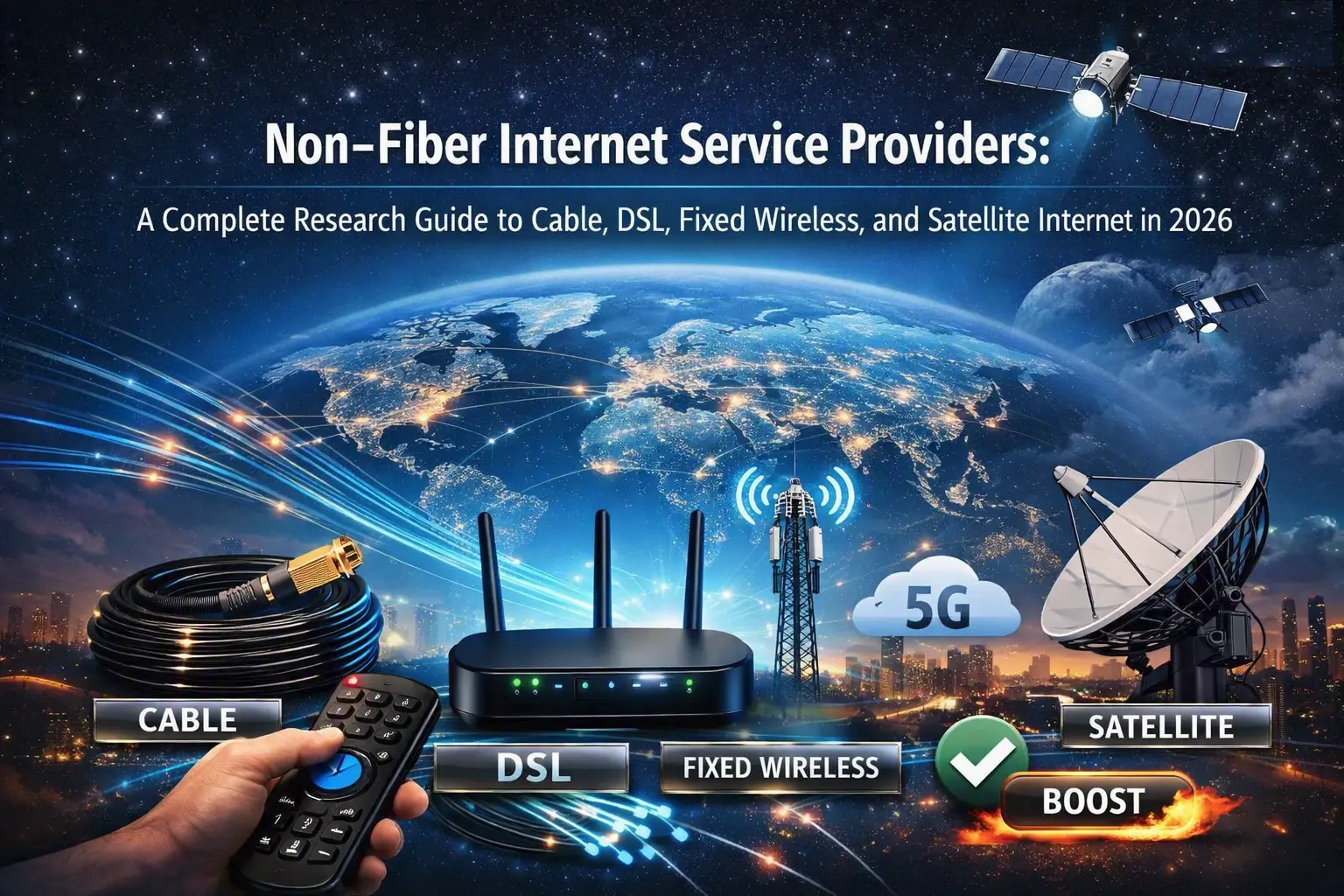
Non-Fiber Internet Service Providers: A Complete Research Guide to Cable, DSL, Fixed Wireless, and Satellite Internet in 2026
Fiber-optic internet gets most of the headlines, but it still is not available everywhere. As of the FCC's 2026 Section 706 Report, roughly 96.9% of Americans have access to some fixed broadband service at 100/20 Mbps — yet a meaningful share of those connections still run over non-fiber infrastructure: coaxial cable, copper-based DSL, fixed wireless radios, and satellites in low Earth orbit. For millions of households, particularly in suburban and rural areas, these technologies remain the only realistic path to online access, or the most cost-effective one.
This report examines the current state of non-fiber internet service providers (ISPs) in the United States — how each technology works, which companies dominate each category, how they perform against one another, and what the data suggests about where the market is headed. It is written as a research resource for consumers comparing providers, not as a sales pitch for any single company.
Quick Answer
Non-fiber internet refers to any fixed broadband connection that does not run fiber-optic cable directly to the home. The four primary categories are:
Cable internet (Xfinity, Spectrum, Cox, Optimum, Mediacom, Sparklight) — delivered over coaxial hybrid-fiber-coax (HFC) networks, still the dominant U.S. residential broadband technology.
DSL internet (AT&T Internet, CenturyLink/Lumen, Frontier's copper tiers) — delivered over existing copper telephone lines, generally the slowest and most limited non-fiber option.
Fixed wireless access, or FWA (T-Mobile 5G Home Internet, Verizon 5G Home Internet) — delivered from a cell tower to a receiver at the home, the fastest-growing segment in the category.
Satellite internet (Starlink, Viasat, HughesNet) — delivered from orbiting satellites, the main option in areas with no wired or wireless infrastructure at all.
According to industry analyst Kagan (S&P Global Market Intelligence), cable is projected to retain roughly 61.9% of U.S. residential broadband market share through 2026, telecom/DSL is projected to fall below 25%, fixed wireless is expected to climb from about 8% to 12.6% of subscribers, and satellite is expected to hold around 1% of the residential market.
Key Findings
Cable still leads by a wide margin. GlobalData projects cable will represent about 58% of total U.S. fixed broadband access lines by 2028, even as it slowly cedes ground to fiber and fixed wireless.
Fixed wireless is the fastest-growing non-fiber category. GlobalData forecasts FWA subscription share will more than double from 7.2% in 2023 to 15.8% in 2028, driven by low-cost 5G home internet plans from Verizon and T-Mobile.
DSL is shrinking rapidly. The FCC's 2026 Section 706 Report notes copper-based subscriptions falling in several states as customers migrate to faster fixed broadband alternatives.
Speed reliability varies significantly by technology. Cable and fiber providers deliver close to their advertised speeds in most cases, while DSL providers deliver roughly 85% of promised speeds on average, and fixed wireless performance varies more by location and network congestion.
Customer satisfaction is improving across most non-fiber categories. The American Customer Satisfaction Index (ACSI) puts the non-fiber ISP category at a score of 71 out of 100 in 2026, up from 70 in 2025, with fixed wireless carriers posting the highest scores in the category.
Regulatory momentum favors expanded non-fiber coverage. The FCC's 2026 report highlights that 23 states now have more than half of locations served by fixed wireless at 100/20 Mbps, reflecting rapid buildout in areas that previously depended on DSL or satellite.
Cable Internet: The Established Workhorse
Cable internet runs over hybrid-fiber-coax (HFC) networks — fiber from the provider's core network to a neighborhood node, then coaxial cable for the final stretch into the home. Major cable providers include Xfinity (Comcast), Spectrum (Charter Communications), Cox, Optimum (Altice USA), Mediacom (Xtream), and Sparklight (Cable One).
Cable's advantage is reach and speed consistency. Most cable networks already support download speeds of several hundred megabits per second to over a gigabit, and providers are actively upgrading to DOCSIS 4.0, a standard capable of supporting multi-gigabit downstream and several-gigabit upstream capacity. That upgrade path is largely why Kagan projects cable retaining the majority of residential broadband share through 2026 despite growing fiber competition.
The tradeoff is asymmetry: cable connections typically offer much faster download than upload speeds, which matters for households doing heavy video conferencing, large file uploads, or cloud backups.
DSL Internet: The Legacy Option in Decline
Digital Subscriber Line (DSL) internet uses existing copper telephone wiring, the same infrastructure originally built for landline phone service. Providers like AT&T Internet and CenturyLink (Lumen Technologies) still offer DSL in areas where fiber has not yet been built, and Frontier Communications maintains copper-based tiers alongside its expanding fiber footprint.
DSL's central limitation is distance sensitivity — speed drops the farther a home is from the provider's central office or remote terminal, which is why DSL performance varies so widely from one address to the next, even within the same city. Research on FCC broadband data shows that cable and fiber networks deliver speeds close to what's advertised in the vast majority of cases, while DSL providers deliver on the order of 85% of their advertised speeds on average — a meaningful gap for households relying on it for video calls or streaming.
The category is in structural decline. The FCC's 2026 Section 706 Report specifically cites states, including North Carolina, where copper-based subscriptions fell by well over 100,000 even as overall fixed broadband subscribership rose — evidence that DSL customers are actively migrating to cable, fiber, or fixed wireless where those options become available.
Fixed Wireless Access: The Fastest-Growing Alternative
Fixed wireless access (FWA) delivers broadband from a cellular tower to a receiver installed at the home, using 4G LTE or 5G spectrum rather than any physical wire. T-Mobile 5G Home Internet and Verizon 5G Home Internet are the two largest residential FWA brands in the U.S., and both have expanded aggressively into suburban and rural markets that previously depended on DSL or satellite.
FWA's appeal is straightforward: no buried cable or drilled conduit is required, installation is often self-service, and pricing tends to undercut cable in many markets. Industry analyst GlobalData points to easy self-installation, affordability, and the reliability of underlying 5G technology as FWA's core selling points versus incumbent wireline services, noting it works well both as a primary connection and as a backup internet option.
Performance depends heavily on tower proximity and network load — a home near a well-provisioned 5G site can see cable-competitive speeds, while a home at the edge of coverage may see substantially less. The category's rapid growth is reflected in the ACSI's 2026 customer satisfaction data, where both major FWA carriers posted some of the highest scores among all non-fiber providers.
Satellite Internet: The Coverage-of-Last-Resort Option
Satellite internet remains the technology of last resort for the most remote U.S. locations — areas without cable, DSL, or fixed wireless coverage at all. Starlink (low Earth orbit) has substantially changed the category's performance profile compared to older geostationary services like Viasat and HughesNet, cutting latency from roughly 600+ milliseconds down to figures much closer to cable and fixed wireless.
Even with Starlink's improvements, satellite remains a niche category. Kagan projects residential satellite broadband holding around just 1% share of the market through 2026, reflecting cost and, for geostationary providers, latency limitations relative to terrestrial alternatives. It remains, however, the only viable connection for many farms, remote cabins, and locations far outside any wired or wireless buildout.
How the Categories Compare
Technology | Typical Download Speeds | Key Strength | Key Limitation | Representative Providers |
|---|---|---|---|---|
Cable | 100 Mbps – 1+ Gbps | Wide availability, strong reliability | Upload speeds much lower than download | Xfinity, Spectrum, Cox, Optimum |
DSL | 5 – 100 Mbps | Available almost anywhere phone lines exist | Speed drops sharply with distance from provider hub | AT&T Internet, CenturyLink, Frontier (copper tiers) |
Fixed Wireless (FWA) | 50 – 300+ Mbps | Fast self-install, competitive pricing | Speed varies with tower distance and congestion | T-Mobile 5G Home Internet, Verizon 5G Home Internet |
Satellite | 25 – 220+ Mbps | Available virtually anywhere with sky access | Higher latency (especially geostationary); weather sensitivity | Starlink, Viasat, HughesNet |
Future Outlook
The trajectory suggested by current research points toward a continued reshuffling within the non-fiber category rather than its disappearance. Cable will likely remain the largest single non-fiber technology through the rest of the decade, defended by DOCSIS 4.0 investment, even as fiber overbuilds erode its lead in urban cores. DSL will continue shrinking as carriers prioritize fiber buildout and copper retirement, particularly as federal programs like the Broadband Equity, Access, and Deployment (BEAD) program direct funding toward unserved and underserved areas. Fixed wireless is positioned to be the primary disruptor within the non-fiber space, and GlobalData's projection of FWA reaching nearly 16% of fixed broadband subscriptions by 2028 suggests it will increasingly be a first choice, not just a fallback, in many markets. Satellite will likely remain a small but essential slice of the market, serving the geographies no other technology can economically reach.
Frequently Asked Questions
What counts as "non-fiber" internet?
Non-fiber internet includes any fixed broadband connection where fiber-optic cable does not run directly to the home. This covers cable internet (fiber to the node, coax to the home), DSL (copper telephone lines), fixed wireless access (cellular signal to a home receiver), and satellite internet (signal from orbit).
Is cable internet faster than fiber?
Not typically at the high end — fiber generally offers faster and more symmetrical upload speeds. However, modern cable networks upgrading to DOCSIS 4.0 can deliver download speeds competitive with many fiber plans, making the practical difference smaller than it once was for typical household use.
Why is DSL internet so much slower than other options?
DSL speed depends heavily on the physical distance between a home and the provider's nearest network equipment. The farther the copper line runs, the more the signal degrades, which is why DSL speeds vary widely by address even within the same neighborhood.
Is 5G home internet (fixed wireless) reliable enough to replace cable?
For many households, yes. Fixed wireless has grown rapidly because it offers cable-competitive speeds with simpler installation and often lower pricing. Reliability depends on proximity to a well-provisioned tower and local network congestion, so it's worth checking real-world performance reports for a specific address before switching.
How does satellite internet compare to other non-fiber options?
Modern low-Earth-orbit satellite services like Starlink have significantly lower latency than older geostationary satellite services, making them viable for video calls and other real-time uses. Satellite remains the most expensive non-fiber category per month in most markets and is generally chosen only where no wired or wireless alternative exists.
Which non-fiber technology has the best customer satisfaction?
According to 2026 American Customer Satisfaction Index data, fixed wireless providers and Starlink scored notably higher than the non-fiber category average, while some legacy cable and DSL providers scored lower, though several posted meaningful year-over-year improvement.
Will fiber eventually replace all non-fiber internet options?
Not in the near term. Fiber deployment is capital-intensive and geographically uneven, and federal programs are prioritizing currently unserved areas first. Cable, fixed wireless, and satellite are each expected to retain meaningful market share through at least 2028 according to industry forecasts.
How do I find out which non-fiber providers serve my address?
Availability varies block by block, especially for DSL and fixed wireless. Checking address-level availability directly with providers, or through a resource like CtvforMe.Com, is the most reliable way to confirm real options before comparing plans.
Conclusion
Non-fiber internet is not a shrinking afterthought to the fiber buildout story — it is a shifting, multi-technology market in its own right. Cable remains the backbone of U.S. residential broadband for now, DSL is fading as copper networks age out, fixed wireless is emerging as the category's clear growth story, and satellite continues to fill the coverage gaps nothing else can reach. Understanding how these technologies differ in speed, reliability, installation, and long-term trajectory gives consumers a much better basis for choosing a provider than advertised speed alone. Readers can explore current non-fiber provider options and availability by address at CtvforMe.Com or by calling (855) 210-8883.